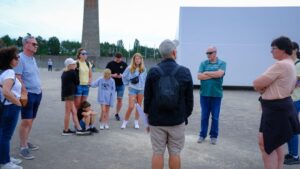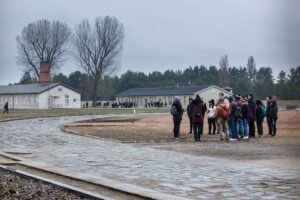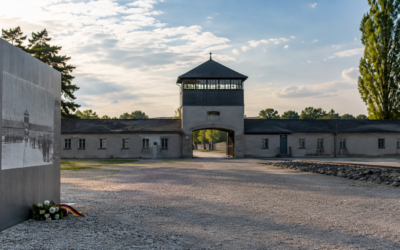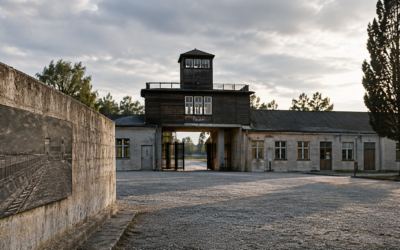
You stand on a vast, open gravel field. Wind comes across it with nothing to stop it. Your first instinct is to look for what explains the place: a monument, a sign, a single object that tells you what you are looking at. There isn’t one. The emptiness is the explanation.
That is the first surprise for most visitors to Sachsenhausen. The roll call square, the Appellplatz, looks like nothing. Understanding what happened there means understanding why such a plain space was the most feared place in the camp.
Why a Parade Ground Became a Weapon
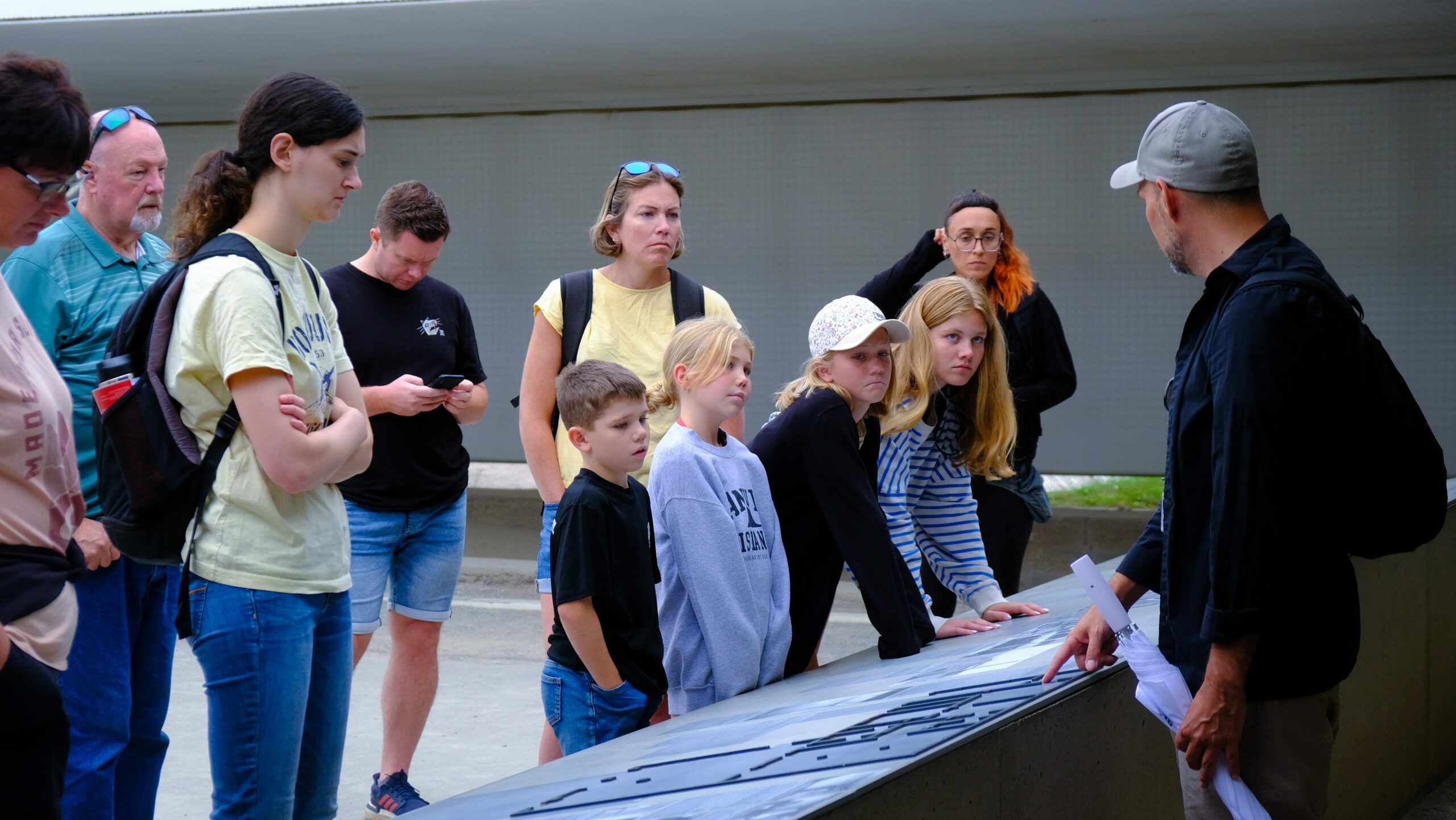
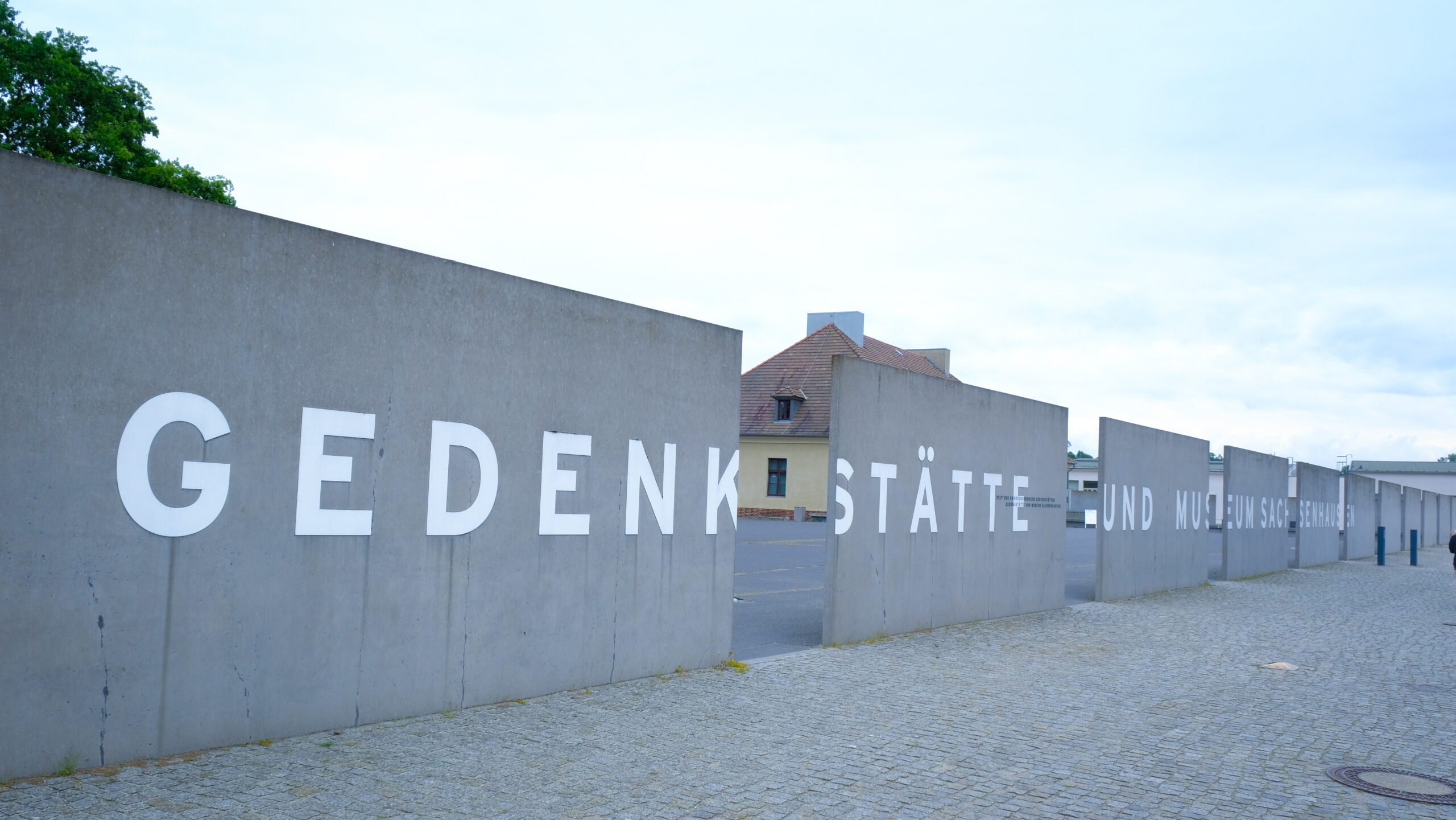
Sachsenhausen is in Oranienburg, just north of Berlin. It was planned with all the buildings spreading out from one point: the barracks stretched in a semicircle,, and the roll call square sat at the center, visible from the main gate tower. This arrangement made it obvious that each prisoner could be seen, counted, and controlled from a single position.
Prisoners were required to stand in rows and be counted twice each day, regardless of the season. The count had to be exact; if a man was missing, having died during the night, escaped, or been hidden in a barrack, everybody had to remain standing until the numbers agreed. Hours would pass, and the men, weak and not given enough food, stood in their thin clothes through the winter dawns.
Want to understand another part of prisoners’ daily experiences at Sachsenhausen? Read our blog on The Sachsenhausen Shoe-Testing Track: Why Prisoners Were Forced to March for Miles to learn about the forced marching and labor on the track.
The Mistake Almost Everyone Makes: Mixing Up the Camps
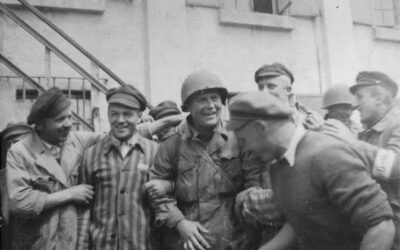
If you spend any time reading about camp history online, you will run into a persistent confusion. People merge the stories of different camps into one. The best-known example involves Dachau, near Munich, which was liberated by American troops on 29 April 1945.
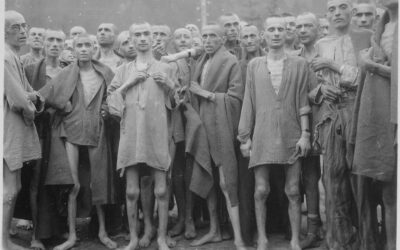
Dachau’s liberation is the source of a famous and disputed photograph. The caption usually claims that inmates are about to execute an SS guard with a shovel. Historians and careful readers have strongly challenged this. One account says the photo does not show an execution at all. According to that account, a group of guards was lined up, one ran and was shot, and the others thought they were being executed and dropped to the ground, which is why a few men in the image are still standing.
The Trial That Brought the Square Back Into the Headlines
For decades, the question of who was responsible for what happened at Sachsenhausen felt like a closed book. Then a courtroom reopened it.
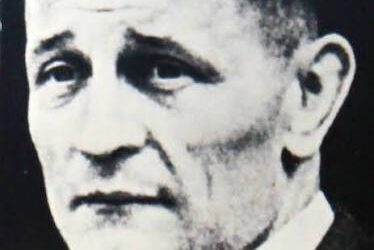
Josef Schütz, who served at the camp between 1942 and 1945, was sentenced to five years in prison for complicity in murders. He was 101 years old, the oldest person ever to stand trial for Nazi-era crimes.
Reactions were split, and the arguments are worth knowing because you will hear versions of them from other visitors. One side said it was far too late and pointless to punish a man of that age. Another argued that he was in his twenties at the time, so he could not have been in charge of anything, and that if guards are to be judged, then everyone who failed to intervene must be judged too.
What It Feels Like to Walk It Today
Visitors who have walked these grounds describe the same two sensations. One is shock at how ordinary the surroundings are. At Dachau, a visitor noted that the camp sits inside the town, with houses right up against the fences. It is not remote. Oranienburg has a similar quality: a normal town, a normal commute, and a camp at the end of the street.
The other kind is a sudden onset of heaviness. A person who had toured following a rowdy Oktoberfest weekend stated that the trip made them sober right away. Another person went twice and wanted to go a third time as a form of tribute, saying you have to be there to understand it.
Want to learn more about the medical history of the camp? Read our blog on The Infirmary at Sachsenhausen: Medicine, Murder and Human Experimentation to explore what took place there.
Why Seeing It in Color and Hearing It From the Source Changes Things
Many people point to the same turning point, the moment when history stopped feeling distant. In one case, it was seeing color photographs, since black and white makes the past seem as if it comes from a completely different world, even though it actually took place only eighty years ago, within the span of a single lifetime. In other instances, they remember visits to the classroom by survivors, during which an older man would speak straightforwardly, and the adults present would go quiet.
Many of the soldiers who liberated the camps barely spoke about it afterward. One grandson recalled the look of fear and helplessness in his grandfather’s eyes when Dachau came up. Another family had a one-line piece of advice from a veteran grandfather. Researchers have noticed this pattern too: those who actually stood inside the camps were often less willing to talk about it than people who never saw them.
That silence is part of the history. It is worth carrying with you onto the square.
A Note on Denial
You may meet someone online or in person who claims the evidence is invented, usually by picking at a detail such as a chimney’s height. These arguments rely on one trick: pick an odd detail, then claim everything collapses if it doesn’t fit.
The evidence does not work that way. It includes mountains of survivor testimony, confessions and writings from perpetrators, and German documentation of the programs. Scholars debate details all the time, and that is normal. The basic facts are not in doubt.
FAQs
- Were SS guards really executed with shovels after liberation?
The famous photo captioned that way is disputed. One widely repeated account says it shows guards who dropped to the ground after one man ran and was shot, not an execution scene. Reprisals against guards did happen at Dachau, with estimates of roughly 35 to 50 killed, but the photo is not reliable proof of the details.
- Were the guards in the background of that photo killed too?
Some accounts say many of them were shot by an American machine gunner, with the number often given as around 60. Historians disagree on the exact sequence and count, so treat any single caption with caution.
- Could a young guard be held responsible if he was not in charge?
Yes. In the Schütz case, a court convicted a man who served in his twenties of complicity in murders at Sachsenhausen. Complicity depends on taking part in the killing system, not on holding a command position.
- Was it really impossible for Germans to refuse to take part?
Not always. Historians point to Police Battalion 101, whose commander offered men the chance to step out of the killings. Only a minority of Germans were Nazi Party members at the peak, and many people kept their distance or resisted quietly.
- What happened to prisoners after liberation, such as men persecuted for being gay?
Some did not gain true freedom. Because homosexuality was still criminalized in Germany at the time, some prisoners who had been persecuted for being gay were moved into regular prisons after the camps were liberated.