Picture yourself receiving a pair of shoes that don’t fit, carrying a heavy pack, and being told to walk in circles until the sun sets. There would be no destination and no obvious purpose. Instead, you’d move along a route where the ground changed texture every few meters, and guards decided whether you could stop.
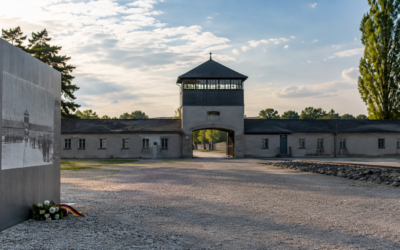
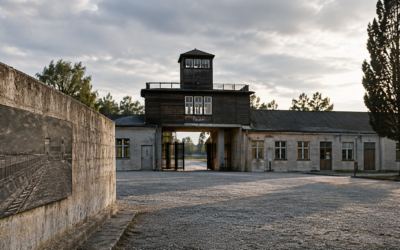
That was daily life for the men assigned to the shoe testing track at Sachsenhausen, a concentration camp just north of Berlin. If you have ever wondered why anyone would design such a thing, the answer is both simpler and more disturbing than most people expect.
What the Track Actually Was
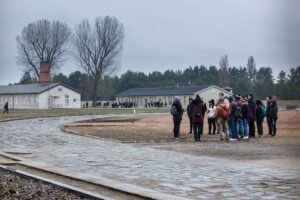
The shoe-testing track was a looping route within the camp and included a variety of surfaces, including gravel, cinder, sand, asphalt, and cobblestone. Because wartime shortages drove German shoe manufacturers to use substitute materials, they wanted to see how well the new soles and materials performed under severe use; records indicate the established companies used the camp as a free laboratory.
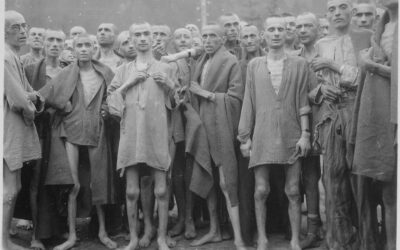
Because the camp needed test subjects, it kept thousands of people it regarded as disposable. The prisoners assigned to the shoe detail were made to walk for hours at a fast pace, sometimes covering thirty kilometers or more each day and often carrying heavy packs. According to survivor accounts, their feet were blistered and bleeding, men collapsed, and the guards saw any slowing down as a violation. Prisoners were frequently given this duty as punishment, meaning the work was meant to cause pain as much as it was meant to measure performance.
Therefore, the truthful answer to the question in the headline is that the march had two objectives at once. In theory, it was intended as a means of testing products; in reality, it was a way of killing people by exhausting them, providing the murder with an industrial justification.
Why “Pointless” Exercise Was Part of the System
The shoe print may seem oddly familiar since harsh and pointless physical work is carried out all over the camp. At Mauthausen, the guards made prisoners do tiring drills and even humiliating games such as leapfrog. Both survivors and historians have described how the guards made people run in circles until they were no longer able to go on, and those who fell were then chosen for the gas chamber or the firing squad. Those prisoners who still met the required standard would survive another day in the quarries or on other forms of forced labor.
That point sheds a great deal of light on the situation. Exercise in these camps served to sort the prisoners; it humiliated them, amused the guards, and quietly revealed who was weakening. The same principle applied to the Sachsenhausen track with one additional twist: it presented the cruelty as research.
A story from another former prisoner illustrates how this pattern continues whenever power goes unchecked. At the Yugoslav island prison Goli Otok, known as the naked island, it is said that the prisoners were made to take rocks from one side of the island to the other and then carry them back again; in a different regime, in a different decade, the same harsh principle was followed. Forced labor with no objective is a method of breaking people’s minds.
Want to understand more about daily life at Sachsenhausen? Read our blog on What Happened on Sachsenhausen’s Roll-Call Square? to learn about the significance of this central area of the camp..
Why This Story Still Matters
Mass atrocity is rarely shown in an obvious form of evil; instead, it is often hidden in paperwork, schedules, and plausible justifications like product testing, administrative procedures, or simply obeying orders. The shoe-testing track is a frightening example of how ordinary commercial aims can connect to cruelty and how quickly human beings can become mere material.
Understanding it is not about morbid curiosity. It is about recognizing the pattern early enough to refuse it.
Want to see what remains of the camp today? Read our blog on Sachsenhausen’s Barracks: What Is Original and What Has Been Reconstructed? to understand which parts are original and which have been reconstructed.
Frequently Asked Questions
- Why were prisoners forced to do pointless exercise in camps like Sachsenhausen and Mauthausen?
It had a number of purposes: it was used for humiliating prisoners, for entertaining the guards, for wearing people down, and for identifying those who were weak enough to be chosen for murder. At Sachsenhausen, the shoe print provided a commercial reason for the cruelty.
- What happened to prisoners who could not keep up during forced exercise?
At Mauthausen, those who collapsed could be sent to the gas chambers or the firing squad, while those who remained fit enough might survive another day in the quarries or other forced labor.
- What happened at Sachsenhausen after liberation?
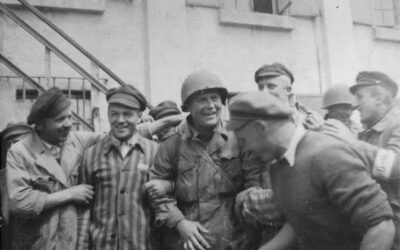
On April 22, 1945, the Soviet forces discovered approximately 3,400 prisoners, and the NKVD continued to operate the camp until 1950, when about 12,000 additional people died while under Soviet control.
- Why did SS guards deny responsibility at their trials?
It was often a legal tactic; under German law there was a distinction made between murder and less serious offenses, as well as between the perpetrators and the accomplices, which meant that presenting oneself as a mere administrator or as just one link in the chain could result in a lighter sentence. Although the early Allied tribunals rejected this argument, later courts in West Germany generally accepted it.
- Is it worth visiting a former camp in person instead of learning online?
Many visitors say yes. People who have walked these grounds describe a level of understanding that photographs and videos cannot deliver, especially when preserved belongings and personal records are part of the experience.