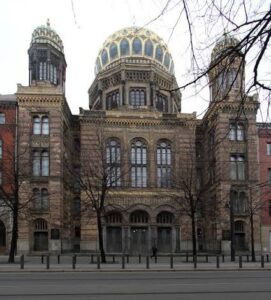
Wer in der Oranienburger Straße steht und die goldene Kuppel betrachtet, stellt sich unweigerlich dieselbe Frage: Wie konnte dieses Gebäude Nazideutschland und die Bombenangriffe überstehen? Die gängige Erklärung lautet, es sei schlichtweg zu schön gewesen, um zerstört zu werden. So schön diese Geschichte auch ist, sie stimmt nur teilweise. Die wahre Antwort ist überraschender, menschlicher und verändert die Art und Weise, wie man das Gebäude bei einem Besuch betrachtet.
Die Kurzfassung dessen, was passiert ist
Auch die Neue Synagoge in Berlin-Mitte blieb nicht verschont. Sie wurde in der Reichspogromnacht im November 1938 angegriffen, und nur ein Polizist rettete sie, indem er den Brandstifter aufhielt, bevor sich das Feuer ausbreiten konnte. Die Polizei wurde später für diese Rettung gerügt. Die Gemeinde beseitigte die Schäden rasch. Die Bombenangriffe von 1943 vollbrachten dann das, was der Brandanschlag nicht vermocht hatte, und der große Saal wurde weitgehend zerstört.
Only the better preserved front half of the building survived. After the war, they demolished the ruined Great Hall and never rebuilt it. That is why the building you see today is so much shorter than you would expect for something with such a großer EinzugDie verlorene Hälfte ist heute ein offener Platz. Falls Ihnen die Proportionen etwas ungewöhnlich vorkommen, interpretieren Sie das Gebäude richtig. Sie betrachten ein Fragment – und zwar ein bewusst authentisches.
The front part, which had a sound structure, was restored from 1988 to 1993, and the dome you appreciate is new. Therefore, the correct response to the question ‘what has survived’ is that only the facade, the memory, and the decision not to pretend otherwise remain.
Möchten Sie mehr darüber erfahren, wie Berlin seiner jüdischen Gemeinde gedenkt? Lesen Sie unseren Blogbeitrag auf Stolpersteine: Die kleinen Gedenkstätten to discover the small memorials found throughout the city.
Warum die Straßenfront immer noch Menschen abhält
Berliner, die das Gebäude lieben, äußern sich meist ähnlich über seinen Stil. Die maurische Architektur beweist, dass man nicht an Traditionen festhalten muss, um Schönheit zu schaffen, solange man Handwerkskunst und Kontext respektiert. Die Fliesenmuster, die hufeisenförmigen Details und die vergoldete Kuppel verleihen dem Gebäude ein unverwechselbares Aussehen in der Straße.
Hier ein einfacher, praktischer Tipp: Verbringen Sie die meiste Zeit im Freien. Die erhaltene Fassade ist wirklich beeindruckend. Gehen Sie auf die andere Straßenseite, um die Kuppel zu betrachten, und nähern Sie sich dann den Details. Das frühe Morgenlicht kommt dem Gebäude besonders gut entgegen, und Sie haben den Gehweg fast für sich allein, da weniger Touristen unterwegs sind.
Was Sie erwartet, wenn Sie hineingehen
Hier sollten Sie Ihre Erwartungen nicht zu hoch schrauben, denn genau hier werden Besucher enttäuscht. Abgesehen von den Räumen, die einer religiösen oder repräsentativen Funktion dienten, ist die Innenausstattung eher unscheinbar. Der Gebetsraum existiert nicht mehr. Du gehst through the surviving front section, not the vast worship space that once stood behind it.
Der Bereich hinter dem Gebäude ähnelt eher einem Hinterhof als einem Garten und darf nicht einfach betreten werden. Sie müssen die Sicherheitskontrolle am Eingang passieren und einen triftigen Grund für Ihren Besuch haben. Die Sicherheitsvorkehrungen an jüdischen Einrichtungen in Berlin sind real und dauerhaft und gehören zum Alltag – sie sind kein Anzeichen für Probleme. Bringen Sie Ihren Personalausweis mit, planen Sie genügend Zeit ein und verhalten Sie sich den Sicherheitsbeamten gegenüber höflich und geduldig. Rechnen Sie nicht damit, unangemeldet hindurchgehen zu können.
Ein kleiner praktischer Vorteil: Ein Stück weiter die Straße hinunter, rechts von der Synagoge, befindet sich ein wunderbares mexikanisches Restaurant; nach so viel Geschichte ist eine einfache Mahlzeit ein paar Schritte entfernt eine angenehme Abwechslung.
Die Synagoge, die Sie nicht besuchen können: Fasanenstraße
To understand why the New Synagogue matters, you need to know about its liberal counterpart in Charlottenburg. The Fasanenstraße synagogue opened on 26 August 1912 and was the main synagogue of Berlin’s more liberal Jewish community. It burned on 9 November 1938 and was finally destroyed in the bombing of 1943.
Das ist die wichtigste Lehre aus Berlins jüdischer Architektur. Besucher nehmen oft an, eine einzige große Synagoge habe die gesamte Gemeinde repräsentiert. Tatsächlich gab es in Berlin verschiedene jüdische Gemeinden mit unterschiedlichen Traditionen, jede mit ihren eigenen Gebäuden, von denen viele heute nicht mehr existieren. Die Neue Synagoge überstand das Regime insofern, als ein Teil von ihr erhalten blieb. Die Synagoge in der Fasanenstraße hingegen nicht.
Ein kurzer Hinweis zur Sprache, denn Sie werden dies in Berlin häufiger hören. Der alte Begriff „Reichskristallnacht“ wird heute weitgehend vermieden, und viele Berliner bevorzugen „Pogromnacht“. Kristalle werden mit etwas Hellem und Positivem assoziiert, und das Geschehene war alles andere als das. Mit „Pogromnacht“ wirken Sie informiert und respektvoll.
Other survivors, and why some buildings lived
The synagogue survived not because of beauty or bravery. A Berliner recalls a simple yet pleasant brick synagogue near where they grew up. The building was not preserved for practical reasons, since it sat within a city block and a fire would have spread to the adjacent houses. This is a stark reminder that some buildings survived in 1938 thanks to their neighbors rather than their own merits.
Wer tiefer in die Materie eintauchen möchte, dem sei die jüdische Künstlerin Andrea Strongwater empfohlen. Sie hat jahrelang Europas verlorene Synagogen gemalt und die umliegenden Gemeinden erforscht. Ihre Werke sind eine bewegende Ergänzung zu einem Synagogenbesuch. Auch die Große Synagoge von Warschau fällt immer wieder, wenn von den zahlreichen europäischen Synagogen die Rede ist, die in den 1930er und 40er Jahren zerstört wurden.
If you want to attend a service, not just see a building
Viele Menschen Ankunft in Berlin wanting more than a photo. They want to belong somewhere, especially over the high holidays, and this is where newcomers struggle most.
The frustrating truth is that access varies enormously. One newcomer from the United States who lives in Charlottenburg tried two years in a row to attend high holiday services, focusing on the Pestalozzistraße synagogue. Advance registration was required. The E-Mail-Adresse on the website replied only the day before Rosh Hashanah, saying there was no space left. The following year, after writing three weeks ahead, they were pointed to two other email addresses and two phone numbers. Nobody answered. Compared with their experience in London, Prague and Budapest, it felt unusually closed.
Was tatsächlich funktioniert, basierend auf den Empfehlungen der Einheimischen:
Versuchen Sie es mit mehreren Synagogen. Manche Berliner Gemeinden sind an den Hohen Feiertagen deutlich besser erreichbar als andere, daher sollten Sie gegebenenfalls mehrere Synagogen aufsuchen. Auf der Website der Jüdischen Gemeinde Berlin (jg-berlin.org) finden Sie eine umfassende Liste der Gottesdienste und Kontaktdaten der verschiedenen Synagogen.
It might be a good idea to visit in person; a non-Jewish resident of Berlin familiar with mosque culture explained that various religious communities are overwhelmed von email and phone inquiries, and that asking face to face usually leads to quicker results. However, because of security checkpoints, it’s easier to do this in some places than others, so treat it as a possibility rather than a guarantee.
Für Gottesdienste auf Englisch wenden Sie sich am besten an internationale Besucher. Falls Sie einen englischsprachigen Gottesdienst suchen, gibt es möglicherweise keinen festen Anbieter. Einheimische empfehlen, sich an Chabad und Hillel zu wenden, da Hillel-Studenten dort am ehesten Auskunft geben können. Chabad Berlin ist sehr international und bietet sogar englische Siddurim an, obwohl der Gottesdienst selbst wahrscheinlich nicht auf Englisch stattfindet. Wenn Sie Spanisch oder Portugiesisch sprechen, gibt es auch eine Gruppe, deren Gottesdienste hauptsächlich auf Spanisch und Hebräisch, gelegentlich auch auf Englisch, abgehalten werden. Diese Gruppe trifft sich jedoch nicht in einer festen Synagoge.
Interested in stories of everyday resistance during the Nazi era? Read our Blog on Otto Weidt’s Workshop for the Blind: A Story of Resistance in Jewish Berlin um eine der bemerkenswertesten Geschichten des Mutes aus Berlin kennenzulernen.
Ein Hinweis zu Sicherheit und Kontext
Man sieht Polizeipräsenz und Absperrungen an jüdischen Einrichtungen, und es gibt tatsächlich Nachrichten über Angriffe auf jüdische Gebäude. Ein jüdischer Einwohner Berlins weist darauf hin, dass Angriffe auf jüdische Gebäude und Friedhöfe dutzende Male im Jahr stattfinden. Obwohl es schmerzhafte Rückschläge gab, sind antisemitische Überzeugungen und Gewalt insgesamt in Deutschland rückläufig. Betrachten Sie die Sicherheitsvorkehrungen als normal und lassen Sie sich nicht von den Vorurteilen Fremder in Ihrer Wahrnehmung der Stadt beeinflussen.
Die verlassene Seite der Geschichte
Teilweise stehen jüdische Stätten in Europa leer, und Bilder einer verlassenen Synagoge werfen immer wieder dieselbe Frage auf: Wird jemals wieder Leben und Gemeinschaft an diesen Ort zurückkehren? Diese Frage bildet den emotionalen Kern eines Besuchs der Neuen Synagoge. Das Gebäude ist teils ein Überbleibsel vergangener Zeiten, teils eine Gedenkstätte und zugleich ein lebendiger Ort mit Sicherheitskontrollen, restaurierten Fliesen und einem offenen Platz, wo sich einst der große Saal befand.
FAQs
- Warum wurde die Neue Synagoge in Berlin nicht zerstört?
In der Reichspogromnacht wurde das Gebäude angegriffen und beschädigt, doch ein Offizier verhinderte, dass der Brandstifter das Feuer ausbreitete. Die Gemeinde führte die Restaurierungsarbeiten durch, und 1943 wurde es bombardiert und größtenteils zerstört. Nach dem Krieg wurde nur die besser erhaltene vordere Hälfte wiederaufgebaut.
- Ist die Kuppel original, und wie viel des Gebäudes ist rekonstruiert?
Die Kuppel ist neu, und vieles, was man sieht, ist rekonstruiert. Die statisch intakte Fassade wurde zwischen 1988 und 1993 restauriert. Der Gebetssaal existiert nicht mehr, und die Ruinen der Großen Halle wurden abgerissen, sodass ein offener Platz entstand.
- Darf ich den Innenhof hinter dem Gebäude betreten?
Nicht frei zugänglich. Das dahinterliegende Gebiet gleicht eher einem Hinterhof, und man kann es nur betreten, wenn man den Kontrollpunkt am Eingang mit einem triftigen Grund passiert.
- Wo finde ich eine Synagoge mit englischsprachigen Gottesdiensten?
Locals suggest asking Chabad and Hillel first. Chabad Berlin is very international and has English siddurim, though the service itself may not be in English. The Jewish Community of Berlin website lists services and contacts for other synagogues.
- How do I get into a Berlin synagogue for the high holidays as a newcomer?
Melden Sie sich möglichst früh an, versuchen Sie es mit mehreren Synagogen anstatt nur mit einer, nutzen Sie die Kontaktliste auf jg-berlin.org und überlegen Sie, persönlich nachzufragen, wenn E-Mails und Anrufe unbeantwortet bleiben.