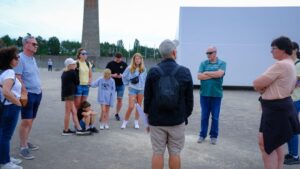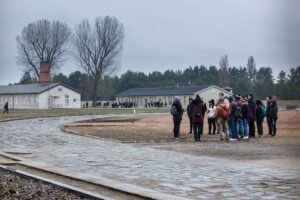
When you pass through the gates of a concentration camp, you are looking for a simple history lesson. But then you notice something strange: a 40-meter-high concrete obelisk stands over the site, a statue of a Soviet soldier looms in the distance, and most of the barracks you imagined are gone. So where did they go, and why does the area feel arranged like a stage set?
The answer is that you are standing inside two layers of history. One is the camp itself. The other is what East Germany decided the camp should mean. To understand Sachsenhausen, you have to read both.
The Day the Camp Became a Monument
Walter Ulbricht, leader of the SED, opened Sachsenhausen as a national memorial on April 23, 1961. The choice of that date was significant since the Berlin Wall was built that August and the East German government was struggling to gain legitimacy on all fronts. If the site of a concentration camp were managed properly, it could act as evidence that the GDR had been on the correct side of history.
So the redesign was never meant to be a place of mourning. Planners built it as a monument to what they called the “Triumph of Antifascism.” Visitors who study the layout will see the difference between a memorial designed to make you grieve and one designed to make you believe something about the present.
The Obelisk and the Red Triangles
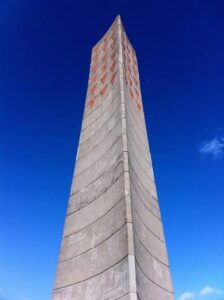
The centerpiece of the 1961 redesign is a 40-meter concrete obelisk. It carries 18 red triangles, the badge the Nazis forced political prisoners to wear. The choice of symbol tells you everything about the story being told.
The GDR narrative put communist resistance at the top of a hierarchy of victims. Political prisoners, and communists above all, were presented as heroes whose struggle ended in victory. People targeted for who they were, rather than what they believed, were pushed to the margins.
The record on this is blunt. When the memorial opened in 1961, there was no separate mention of Jewish victims. Only after fierce protests did the government add sparse, marginal exhibits about Jewish suffering. Jehovah’s Witnesses, homosexuals, and Roma and Sinti were left out of the state narrative entirely.
The Landscape Was Rewritten, Too
The GDR did more than alter the stories on the labels; it changed the very foundation. Some historians describe this change as equivalent to replacing the “Geometry of Total Terror” with the “Triumph of Antifascism.”
Here is what that meant on site:
- Most of the original prisoner barracks were demolished.
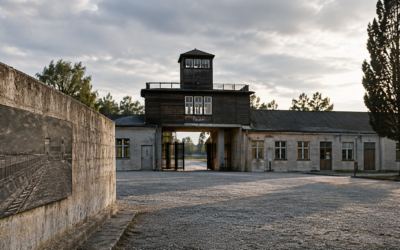
- A perforated concrete wall enclosed the open roll call area, steering your eyes toward the obelisk and a statue of a liberating Soviet soldier.
- The camp was deliberately reduced in size, leaving out the adjacent SS buildings.
That last point is easy to miss. By excluding the SS area, the memorial avoided asking who the perpetrators were and where they lived and worked. The camp became a story about heroic victims and a liberating army, rather than a story about the people who ran it.
The Museum in the Kitchen
The camp museum was housed in the former inmate kitchen, and its exhibitions did a lot of political work. Nazi terror and genocide were framed mainly as tools of monopoly capitalism and industry chasing profit. The deeper roots of Nazi racism and antisemitism barely appeared.
Under that logic, fascism was a product of capitalism, so a socialist state could not produce it. As one explanation of the GDR worldview puts it, the state presented itself as a German reboot, and by definition an antifascist country that bore no responsibility for the Third Reich. The same thinking explains why the Berlin Wall was officially called an “antifascist barrier,” and why the GDR never took part in reparation efforts the way West Germany did.
The exhibitions also drew a hard line between East and West. West Germany was presented as the direct successor to National Socialism, full of unpunished perpetrators, while the GDR was the “new, humanist Germany” that had eradicated fascism for good.
The Chapter That Was Erased
Here is the part that surprises most visitors. From 1945 to 1950, the Soviet Union ran the site as NKVD Special Camp No. 7/No. 1. Thousands of people died there of starvation and disease, including political prisoners, social democrats, and lower level Nazi functionaries.
That history could not coexist with the image of the Soviet Union as a pure, flawless liberator. So it was censored and removed from the memorial’s public presentation for the entire GDR era. A visitor in 1975 could tour Sachsenhausen and never learn that the camp had kept filling with prisoners after liberation.
Was East Germany Really Free of Former Nazis?
This is the question people argue about most, and the honest answer is that it is complicated.
On one side, the ruling party elite largely came from veterans of the prewar Communist Party of Germany, many of them exiles, resistance fighters, or outsiders. Soviet denazification was more rigid than the early West German approach, and in the highest ranks the GDR was arguably cleaner than the West.
On the other side, Cold War priorities did not stop at the Iron Curtain. The people who say denazification was done more rigorously in some respects are right, but the broader picture is that fighting the rival bloc often mattered more than punishing Nazis. Many people moved from Nazi institutions and secret services into GDR government work. Some former Wehrmacht officers were valued for their combat and management experience, and after rearmament, the National People’s Army was led by officers who had been “turned” in Soviet captivity.
More severe criticism focused on culture rather than individuals. Since the GDR insisted that it had no links at all with Nazi Germany, the topic was not taken seriously in schools. Although West Germany also had its shortcomings, a generation in 1968 wanted to know what their parents had done during the war. Many historians believe that the East never went through such a process of coming to terms with the past, and that this lack of reckoning, together with the economic shock of reunification, helped to maintain the conditions in which extremist politics developed.
What happened to the men who ran Sachsenhausen after the Nazi regime fell? Read How Were Sachsenhausen Guards Brought to Justice After the War? to explore the postwar trials, investigations, and efforts to hold former camp guards accountable.
What Changed After 1990
After reunification, the site went through what historians call deideologization. In 1993, Sachsenhausen was integrated into the newly founded Brandenburg Memorials Foundation, and the changes were big.
The Soviet camp era was finally included in a separate museum building that opened in 2001 outside the core historic camp area. The separation is deliberate: it keeps the crimes of one regime from relativizing or downplaying the other.
The order in which the different groups of victims had been presented was abolished. Nowadays, permanent exhibitions include the Jewish prisoners, the Sinti and Roma, homosexuals, and Jehovah’s Witnesses, and the focus has shifted from collective heroic narratives to individual biographies and accounts of personal suffering. The SS troop camp and command headquarters, which the GDR had neglected, are now part of the educational program.
The most striking thing was the decision to omit certain details. The 1961 obelisk is still a historical artifact showing how the GDR handled its memory. Nowadays, the memorial not only informs you about the camp but also explains how a communist regime distorted history in the interest of the Cold War. You are given both the original account and the account of that original account.
FAQs
- How did ordinary East Germans view former Nazis?
It depended on the person and the decade. A believer in party doctrine saw Nazis as a West German problem. Others held more complicated views, and views shifted across the 1950s, 1970s, and 1980s. Reliable large scale studies of ordinary opinion are scarce.
- Is it true there were many former Nazis in the GDR government?
At the top, the leadership was mostly prewar communists, exiles, and resisters. Below that level, some people with Nazi pasts were employed for their skills, and former Wehrmacht officers helped build the military. Both claims have some truth.
- Why did the GDR call the Berlin Wall an “antifascist barrier”?
Because state doctrine said the GDR was antifascist by definition and the West was the heir of the Third Reich. The label fit that story.
- Does Sachsenhausen still show the GDR’s design today?
Yes. The obelisk from 1961 remains as a preserved example of how East Germany dealt with its memory, and the area has been reoriented around the surviving remains of the camp.
- When was the Soviet camp history added, and where can I see it?
The postwar NKVD camp (1945 to 1950) was officially integrated after 1993, with a dedicated museum building opening in 2001 outside the core historic camp area.