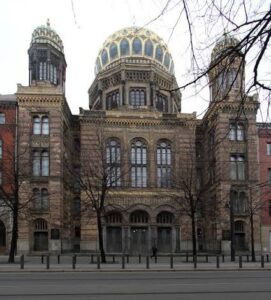
Anyone standing on Oranienburger Straße and looking at that golden dome naturally asks the same question: how did this building survive Nazi Germany and the bombs? The common explanation is that it was simply too beautiful to destroy. Although this is a pleasant story, it is only partly accurate. The true answer is more surprising, more human, and it changes how you should look at it when you visit.
The short version of what happened
The New Synagogue in Berlin Mitte was not spared. It was attacked on Kristallnacht in November 1938, and what saved it that night was one officer who stopped the arsonist before the fire spread. Afterward, the police were reprimanded for saving it. The congregation restored the damage quickly. Then the bombing of 1943 did what the arson could not, and the great hall was largely destroyed.
Only the better preserved front half of the building survived. After the war, they demolished the ruined Great Hall and never rebuilt it. That is why the building you see today is so much shorter than you would expect for something with such a grand entrance. The lost half is now an open plaza. If the proportions feel slightly off, you are reading the building correctly. You are looking at a fragment, and a deliberately honest one.
The front part, which had a sound structure, was restored from 1988 to 1993, and the dome you appreciate is new. Therefore, the correct response to the question ‘what has survived’ is that only the facade, the memory, and the decision not to pretend otherwise remain.
Want to learn more about how Berlin remembers its Jewish community? Read our blog on Stolpersteine: The Small Memorials to discover the small memorials found throughout the city.
Why the street front still stops people
Berliners who love the building tend to say the same thing about its style. Moorish revival architecture proves you don’t have to stick to tradition to create beauty, as long as you respect craftsmanship and context. The tiled patterns, the horseshoe details, and the gilded dome make the building look like nothing else on the street.
Here’s some straightforward, practical advice: spend the majority of your time outdoors. The exterior front face is what remains, and it is truly impressive. Go back to the other side of the road for a view of the dome, then move closer to examine the detailed work. The early morning light suits the building, and you’ll have the pavement to yourself with fewer tour groups.
What to expect if you go inside
Manage your expectations here, because this is where visitors feel let down. Apart from the rooms that served a religious or representative function, the interior is fairly underwhelming. The prayer hall is gone. You’re walking through the surviving front section, not the vast worship space that once stood behind it.
The area behind the building is more like a backyard than a garden, and you can’t wander into it. You have to pass the checkpoint at the entrance and have a valid reason for going in. Security at Jewish sites in Berlin is real and permanent, and it is part of the local reality, not a sign that something is wrong. Bring photo ID, arrive with time to spare, and be polite and patient with the officers. Do not expect to drift through unannounced.
A small practical advantage: a bit further down the street, to the right of the synagogue, there’s a wonderful Mexican restaurant; after going through so much history, a simple meal a few steps away is a pleasant change.
The synagogue you cannot visit: Fasanenstraße
To understand why the New Synagogue matters, you need to know about its liberal counterpart in Charlottenburg. The Fasanenstraße synagogue opened on 26 August 1912 and was the main synagogue of Berlin’s more liberal Jewish community. It burned on 9 November 1938 and was finally destroyed in the bombing of 1943.
This is the sharper lesson of Berlin’s Jewish architecture. Visitors often assume one big synagogue represented the whole community. In reality, Berlin had different Jewish communities with different traditions, each with its own buildings, and many of them are gone. The New Synagogue survived the regime in the sense that part of it remained. Fasanenstraße did not.
A quick word on language, because you will hear this in Berlin. The old term Reichskristallnacht is now widely avoided, and many locals prefer Pogromnacht. They say crystals are associated with something bright and positive, and what happened was anything but. Using Pogromnacht will make you sound informed and respectful.
Other survivors, and why some buildings lived
The synagogue survived not because of beauty or bravery. A Berliner recalls a simple yet pleasant brick synagogue near where they grew up. The building was not preserved for practical reasons, since it sat within a city block and a fire would have spread to the adjacent houses. This is a stark reminder that some buildings survived in 1938 thanks to their neighbors rather than their own merits.
If you want to go deeper, Jewish artist Andrea Strongwater has spent years painting Europe’s lost synagogues and researching the communities that surrounded them. Her work is a moving companion to a visit. The Great Synagogue of Warsaw is another name that comes up constantly when people talk about how many European synagogues were lost in the 1930s and 40s.
If you want to attend a service, not just see a building
Many people arrive in Berlin wanting more than a photo. They want to belong somewhere, especially over the high holidays, and this is where newcomers struggle most.
The frustrating truth is that access varies enormously. One newcomer from the United States who lives in Charlottenburg tried two years in a row to attend high holiday services, focusing on the Pestalozzistraße synagogue. Advance registration was required. The email address on the website replied only the day before Rosh Hashanah, saying there was no space left. The following year, after writing three weeks ahead, they were pointed to two other email addresses and two phone numbers. Nobody answered. Compared with their experience in London, Prague and Budapest, it felt unusually closed.
What actually works, based on what locals suggest:
Try more than one synagogue. Some Berlin congregations are noticeably more accessible than others for the high holidays, so you may need to cast a wider net. The Jewish Community of Berlin website, jg-berlin.org, has a thorough list of services and contact details for the different synagogues.
It might be a good idea to visit in person; a non-Jewish resident of Berlin familiar with mosque culture explained that various religious communities are overwhelmed by email and phone inquiries, and that asking face to face usually leads to quicker results. However, because of security checkpoints, it’s easier to do this in some places than others, so treat it as a possibility rather than a guarantee.
For English, ask the international crowd. If you are looking for a service in English, there may not be a fixed one. Locals suggest contacting Chabad and Hillel, since Hillel students are most likely to know. Chabad Berlin is very international and even has English siddurim, though the service itself is probably not in English. If you are comfortable in Spanish or Portuguese, there is also a group with services mostly in Spanish and Hebrew, with occasional English. However, it does not meet in a fixed synagogue.
Interested in stories of everyday resistance during the Nazi era? Read our blog on Otto Weidt’s Workshop for the Blind: A Story of Resistance in Jewish Berlin to learn about one of Berlin’s remarkable stories of courage.
A note on safety and context
You can observe police and barriers at Jewish sites, and there are indeed news reports concerning attacks on Jewish buildings. A Jewish resident of Berlin points out that attacks on Jewish buildings and cemeteries take place dozens of times each year. Although there have been painful upswings, antisemitic beliefs and violence as a whole have been on the decline in Germany. Treat security as normal, and don’t let strangers’ assumptions shape their view of the city.
The abandoned side of the story
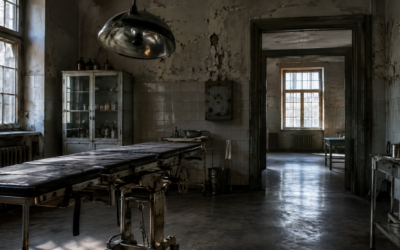
In parts, some Jewish sites in Europe are unoccupied, and pictures of an abandoned synagogue continually raise the same question: will life and community ever come back to this place? This question forms the emotional heart of a visit to the New Synagogue. The building is partly a survivor and partly a memorial, and it is also a current site with security checkpoints, restored tiling, and an open plaza where a great hall used to be.
FAQs
- Why wasn’t the New Synagogue in Berlin destroyed?
On Kristallnacht, the building was attacked and damaged, but an officer prevented the arsonist from spreading the fire. The congregation carried out the restoration, and then in 1943 it was bombed, and much of it was destroyed. After the war, only the better-preserved front half was restored.
- Is the dome original, and how much of the building is reconstruction?
The dome is new, and much of what you see is reconstruction. The structurally intact front was restored between 1988 and 1993. The prayer hall no longer exists, and the ruins of the Great Hall were demolished, leaving an open plaza.
- Can I walk into the courtyard behind the building?
Not freely. The area behind it is more like a backyard, and you can only get there by passing the checkpoint at the entrance with a valid reason.
- Where can I find a synagogue with services in English?
Locals suggest asking Chabad and Hillel first. Chabad Berlin is very international and has English siddurim, though the service itself may not be in English. The Jewish Community of Berlin website lists services and contacts for other synagogues.
- How do I get into a Berlin synagogue for the high holidays as a newcomer?
Register as early as possible, try several synagogues instead of only one, use the contact list at jg-berlin.org, and consider asking in person if email and phone calls go unanswered.