When you get off the train in Oranienburg, you see bakeries, a castle, and a quiet stretch of river. It does not look like the place where an entire country's system of terror was administered. Yet from 1938, the office that directed every concentration camp in the...
camps de concentration
Who Guarded Sachsenhausen? Inside the SS Guard Battalion
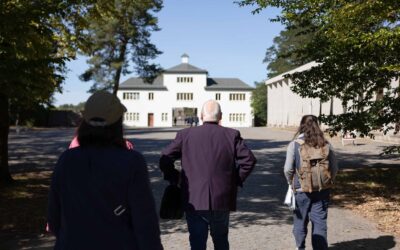
Standing at the gate in Oranienburg, just north of Berlin, almost every visitor asks the same quiet question. Who were the men in the towers? Were they fanatics, careerists, or ordinary men who ended up in a uniform and never found the exit? The short answer is that...
Why Sachsenhausen Became a Model Concentration Camp for the SS
Anyone who looks at an intake photograph in the archives of a camp might ask themselves why a regime determined to destroy should have recorded so much. The reason is that Sachsenhausen was not merely another camp; it was intended to serve as a standard, a model of...
Sachsenhausen’s Satellite Camps: How the Camp Extended Far Beyond Its Main Walls
Most people picture a concentration camp as a single walled Site: a gate, a parade ground, rows of barracks. For Sachsenhausen, that picture covers only part of the story. By the end of the war, the camp at Oranienburg was the center of a regional network of sub-camps...
How German Companies Profited From Sachsenhausen Prisoner Forced Labor
You stand in a quiet corner of Oranienburg, just north of Berlin, looking at a low building most visitors walk past too quickly. Someone beside you says what many people think at some point: 'I've studied this war for years and never heard about this.' That moment of...
Heinkel Aircraft Factory and Sachsenhausen: How Prisoners Were Used to Build Nazi Warplanes
Heinkel's Oranienburg factory and the Sachsenhausen concentration camp were part of one system. The factory built aircraft for the Luftwaffe, and by the middle of the war the camp supplied a large share of the people who built them. This guide covers where the plant...
The Klinkerwerk at Sachsenhausen: The Brickworks Prisoners Feared as a Death Detail
Most visitors to Sachsenhausen walk through the main gate, photograph the iron lettering, circle the triangular roll call ground, and leave believing they have seen the camp. They haven't. Away from the main Site, by the canal near Oranienburg, lies the place...
Comment Build a Berlin WWII & Jewish History Itinerary Around Sachsenhausen
You have three days, a long list of places you're supposed to see, and a feeling that about half of them are just tourist traps. Here's the straightforward truth: Berlin has fewer well-preserved WWII sites than the average visitor anticipates. Since a large part of...
Sachsenhausen and Topography of Terror: Do You Need to Visit Both?
You have three days in Berlin, a long list of things you feel you should see, and a nagging question: do you really need to spend a full day on a train to a concentration camp memorial if you already plan to visit the museum in the city center? Or the reverse: is the...
Operation Bernhard: How Sachsenhausen Prisoners Were Forced to Forge British Money
Imagine a banknote so realistic that the Bank of England itself is said to have mistaken the forgeries for genuine ones. Now imagine who created it: not skilled criminals in a secret workshop, but prisoners in a concentration camp near Berlin, working under the guard...
What Did the Colored Triangles on Sachsenhausen Prison Uniforms Mean?
Stand in front of the famous chart of camp badges, and it looks like a clean, bureaucratic system: a row of colored triangles, each labeled, each meant to tell you exactly who a prisoner was. It is easy to read it like a legend on a map. The uncomfortable truth, which...
Soviet Prisoners of War at Sachsenhausen: What Happened to Them?
If you have ever tried to find a straight answer to this question, you know the problem. Some accounts focus on one famous prisoner; others on millions of nameless men, and the numbers rarely agree. Here is a clear, honest walk-through of what is actually known, and...
Political Prisoners at Sachsenhausen: Who Were Hitler’s Opponents
Anyone who has looked at a black-and-white picture of a camp prisoner and asked who he was, what beliefs he held, and why he was sent there has asked the right question. People often believe the camps were established for a single purpose and for one particular group....
Gay Prisoners at Sachsenhausen: The History of the Pink Triangle
You may have seen the photograph: rows of men in striped uniforms, each with a small pink triangle stitched to the chest, standing in a camp yard at Sachsenhausen on December 19, 1938. It circulates every year, usually with a caption saying the men were freed when the...
The Infirmary at Sachsenhausen: Medicine, Murder and Human Experimentation
If you have ever stood in front of a photograph of a camp 'infirmary' and wondered whether anything good came out of what happened inside, you are not alone. It is one of the most persistent questions people ask about the Nazi camps, and it usually arrives wrapped in...
Sachsenhausen’s Barracks: What Is Original and What Has Been Reconstructed?
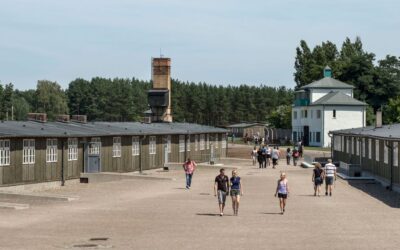
When you pass through the gate, you find yourself in a large gravel-covered area and immediately feel a quiet panic. Nobody knows where the barracks are; most people assume that there will be a series of wooden huts. All they see, in fact, is open ground, a few...
What Happened on Sachsenhausen’s Roll-Call Square?
You stand on a vast, open gravel field. Wind comes across it with nothing to stop it. Your first instinct is to look for what explains the place: a monument, a sign, a single object that tells you what you are looking at. There isn't one. The emptiness is the...
The Sachsenhausen Shoe-Testing Track: Why Prisoners Were Forced to March for Miles
Picture yourself receiving a pair of shoes that don't fit, carrying a heavy pack, and being told to walk in circles until the sun sets. There would be no destination and no obvious purpose. Instead, you'd move along a route where the ground changed texture every few...
Sachsenhausen or Potsdam: Which Berlin Day Trip Should You Choose?
You have a few days in Berlin, one free slot in the schedule, and two very different options pulling at you. One is a place of heavy silence. The other is a city of palaces, lakes, and long walks under old trees. Choosing between them is less about which is 'better'...
Is Sachsenhausen Worth Visiting on a Short Berlin Trip?
Short answer: yes, if you can spare half a day and you are ready for a place that will not entertain you. Sachsenhausen is not a highlight in the usual sense. Nothing about it is photogenic or fun. But it may stay with you longer than anything else on your Berlin...
Gleis 17 Berlin: The Railway Memorial to Jewish Deportations
The vast majority of the people who come to this Page are after the same thing: they want a place in Berlin at which they can stand in silence, experience the heavy impact of what took place, and prevent themselves from being taken in by the tour groups, the selfie...
From Discrimination to Deportation: How Nazi Persecution Escalated in Berlin
If you have ever been on a quiet street in Berlin and wondered how a modern, cosmopolitan city could have come to be among its own neighbors, you are asking the right question. The straightforward answer is unpleasant: it didn't happen all at once, but in small,...
The Rosenstraße Protest: When Berliners Protested the Deportation of Jewish Family Members
Can you imagine being on a cold street in Berlin in late February 1943, with your husband stuck inside a building which you can see but not go into? For ten years, your government has told you that to object is dangerous. Should you go back home and wait, or should...
Otto Weidt’s Workshop for the Blind: A Story of Resistance in Jewish Berlin
The first real problem is that there are two locations named Berlin, and people often mix them up. Otto Weidt Platz is a public square in the area of Moabit, and residents have a running joke about it, referring to it as 'Moabits kleiner BER', a reference to the...
Stolpersteine: The Small Memorials
On your way to the bakery, thinking about nothing in particular, you notice a small piece of brass embedded in the pavement. Next to it, someone has left a tealight. There are no signs and no crowd, merely a name, a birth year, and a date that causes your stomach to...
What Happened to Berlin’s Jewish Community Under the Nazis?
If you are standing in Berlin today and wondering what happened to the people who once made up one of Europe's most confident Jewish communities, the honest answer has three parts. Most were pushed out, many were murdered, and a small number stayed hidden, protected...
Nouveau Synagogue: What Survived
Anyone standing on Oranienburger Straße and looking at that golden dome naturally asks the same question: how did this building survive Nazi Germany and the bombs? The common explanation is that it was simply too beautiful to destroy. Although this is a pleasant...
Jewish Quarter: Why the Story Starts in Berlin
When you arrive in Berlin, you have a practical idea: locate the Jewish Quarter, stroll around it, and get a proper understanding of it. But then you realize that the city doesn't have a single well-defined area you can check off. The story is spread out over brass...
Camp de concentration de Sachsenhausen : comment s’y rendre et le visiter depuis Berlin
Le camp de concentration de Sachsenhausen est l'un des mémoriaux les plus importants d'Allemagne. Situé aux portes de Berlin, il attire chaque année des milliers de visiteurs venus découvrir l'Allemagne nazie, le destin des personnes qui y furent emprisonnées et l'importance du souvenir aujourd'hui. Nombreux sont ceux qui recherchent l'adresse de Sachsenhausen avant leur voyage. D'autres souhaitent connaître le moyen le plus simple de s'y rendre depuis Berlin, savoir si des visites guidées sont proposées et à quoi s'attendre lors de leur visite.
Quelles sont les conditions requises pour les visiteurs du Mémorial du camp de concentration de Berlin ?
De nombreux visiteurs recherchent le « camp de concentration de Berlin », mais le mémorial auquel ils font généralement référence est le Mémorial et Musée de Sachsenhausen à Oranienburg, aux portes de Berlin. Sachsenhausen n'est pas un musée comme les autres. Ancien camp de concentration nazi, il est aujourd'hui un lieu de mémoire et de recueillement. Avant votre visite, il est utile de vous renseigner sur les conditions d'entrée, la tenue vestimentaire recommandée, les règles de conduite, la nécessité de réserver des billets et les émotions que vous pouvez ressentir.