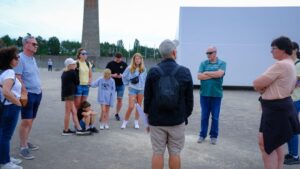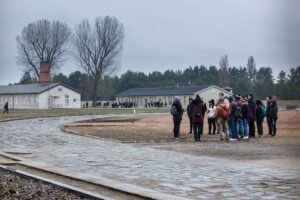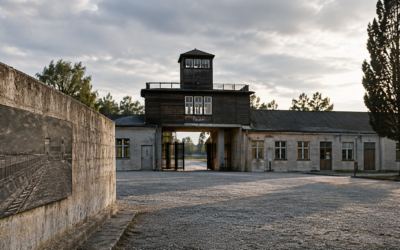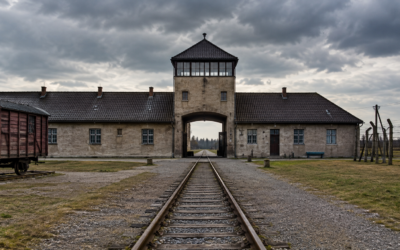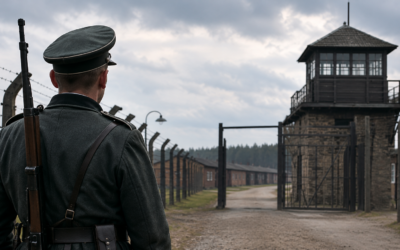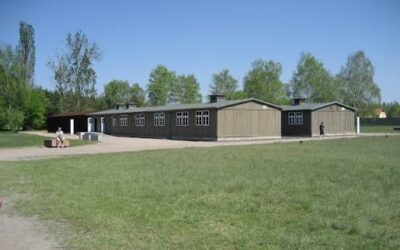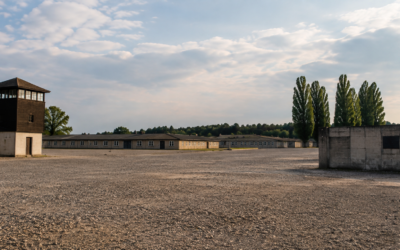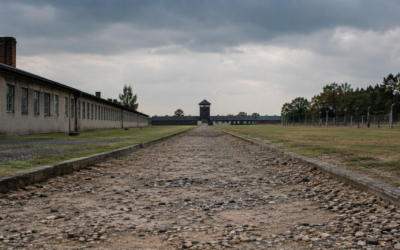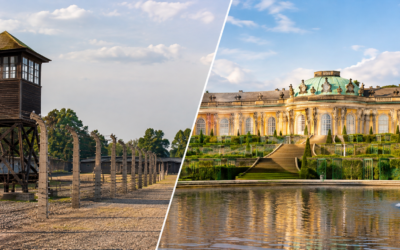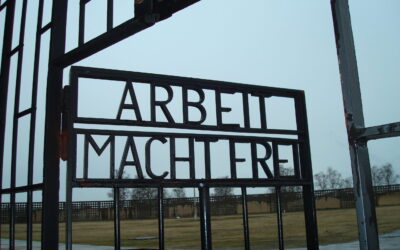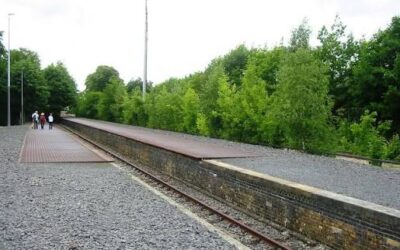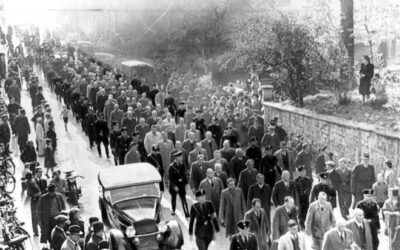
You stand in a quiet corner of Oranienburg, just north of Berlin, looking at a low building most visitors walk past too quickly. For those exploring the wider history of Nazi Germany, a free Berlin walking tour offers additional historical context about the city where many of these wartime decisions were made.
The answer is less comfortable than the standard summary. The camp was not a sealed-off SS world. It was wired into the German economy, and the economy profited.
Why Forced Labor Became Central to the War Economy
When Sachsenhausen opened in 1936, concentration camps were mainly tools of terror and political repression. The war changed their purpose. After the Blitzkrieg stalled and millions of German men were sent to the front, industry faced a severe labor shortage just as armaments demand surged.
Forced labor filled the gap on a huge scale. Over the course of the war, roughly 12 million people were pressed into forced labour for Germany. By summer 1944, foreign civilians and prisoners of war made up around a quarter of the workforce. Concentration camp prisoners were a much smaller share of this total, roughly 700,000 across the whole camp system in early 1945. But they were the most completely controlled and the most expendable.
The change occurred in 1942. Sachsenhausen’s administrative function mattered here because the SS Inspectorate of Concentration Camps had its headquarters in Oranienburg before being incorporated into the SS Economic-Administrative Main Office (WVHA) under Oswald Pohl. In spring 1942, Pohl informed Himmler that the main purpose of the camps had now become armaments production and from that time prisoner labor was regarded as an economic resource to be made available to industry.
Sachsenhausen’s location made it especially valuable: it sat on the edge of Berlin near aircraft plants, engine works, and construction projects, and by 1944 the main camp had numerous subcamps, many connected to specific factories.
How the Money Moved: The SS as Labor Contractor
The mechanism was simple, and it was what made the system profitable:
- A company needed workers and applied to the SS, often through the WVHA.
- The SS agreed to supply several prisoners and set a daily rate per prisoner, commonly cited at around 4 to 6 Reichsmarks depending on skill, sex, and period.
- The company paid the SS, not the prisoner.
- The company also typically provided or paid for guards’ accommodation, transport, and sometimes built a subcamp beside the factory. At the same time, the SS ran the guarding and the starvation-level food supply.
- Prisoners who collapsed were sent back to the main camp and replaced.
The rates varied across sources and over time, so treat any single figure as indicative. The structure is what matters: the labor was cheap, the SS controlled supply, and the worker’s death cost the company almost nothing.
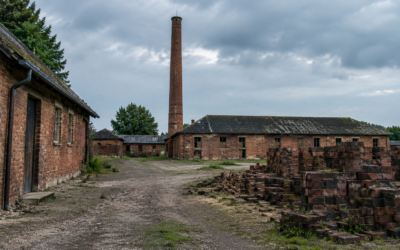
Want to understand one of the specific sites where prisoners were exploited for forced labor? Read The Klinkerwerk at Sachsenhausen: The Brickworks Prisoners Feared as a Death Detail to learn about the brutal conditions at the brickworks.
What the Prisoners Received
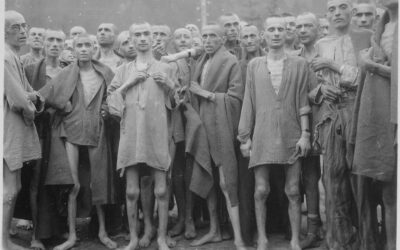
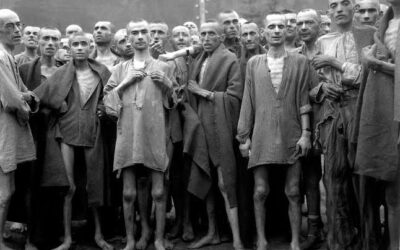
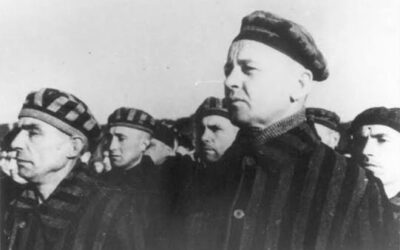
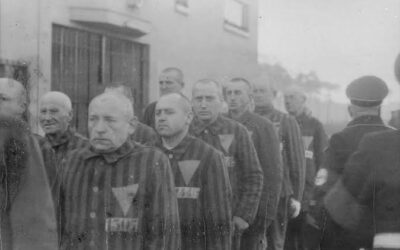
Nothing. No wages passed to the prisoners. They received starvation rations, minimal clothing, overcrowded barracks, and brutal discipline. From 1943, the SS introduced a system of “premium vouchers” meant to boost output, redeemable for small items at the camp canteen or, notoriously, for access to a camp brothel. These were a productivity tool, not pay, and most prisoners rarely obtained them.
Roughly 200,000 people were imprisoned at Sachsenhausen between 1936 and 1945, and tens of thousands died through execution, starvation, disease, medical abuse, and work. In April 1945, as Soviet forces approached, the SS drove tens of thousands of prisoners on death marches.
Which Companies Are Documented at Sachsenhausen
It is important to be precise here. Many famous German firms used forced labour somewhere in the Reich, but that does not mean they used Sachsenhausen prisoners. The firms and operations below are the ones documented in connection with Sachsenhausen and its subcamps. The Sachsenhausen Memorial and German Historical Museum identify several companies that benefited directly from prisoner labour, including Heinkel, Siemens, AEG, Demag, Daimler-Benz and IG Farben.
- DEST (Deutsche Erd- und Steinwerke) and the Klinkerwerk brickworks. This was an SS-owned company, not a private one. Prisoners built and operated a huge brickworks on the Oder-Havel Canal near Oranienburg, producing bricks and stone for Albert Speer’s planned rebuilding of Berlin. Conditions there were among the deadliest in the camp.
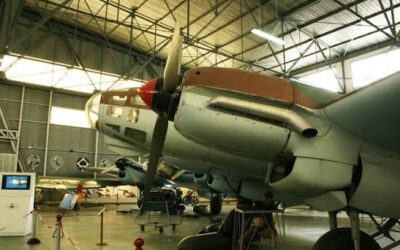
- Heinkel (Oranienburg). The aircraft manufacturer ran a factory in Oranienburg and used prisoners from the camp, alongside other forced laborers. Each is tied to a Sachsenhausen subcamp or work detail attached to its factory
- Demag (Falkensee). A Sachsenhausen subcamp operated from 1943 to 1945, and its prisoners worked at the nearby Demag factory, which manufactured military equipment.
- Henschel (Schönefeld). Prisoners from Sachsenhausen and Ravensbrück were used at the Henschel aircraft works in Schönefeld from 1944.
- Argus Motoren (Berlin-Reinickendorf). Prisoners worked at the aircraft-engine manufacturer’s factory. The subcamp existed from summer 1944 to April 1945 and held about 800 women in September 1944, mostly Hungarian Jewish women transferred from Ravensbrück.
- Arado. Prisoners from Sachsenhausen subcamps supported aircraft production at Arado sites in Berlin and Wittenberg.
- Auergesellschaft (Oranienburg). A chemical firm that used prisoners in its Oranienburg operations through a Sachsenhausen subcamp.
- Siemens (Berlin-Haselhorst and Siemensstadt). Men and women held in Sachsenhausen subcamps worked for Siemens and Siemens-Schuckert in Siemensstadt. The company’s connection to Sachsenhausen prisoner labour is documented in the memorial’s historical records.
- AEG (Berlin). Sachsenhausen subcamps supplied prisoners, including women, to AEG operations in Berlin.
- German shoe manufacturers. In the “shoe testing track” at the camp, prisoners were forced to march for hours in test footwear, used to evaluate products for industry. This was a camp-based testing operation rather than a separately identified company subcamp.
Other well-known firms, including Thyssen, Krupp, Bosch, Junkers, Messerschmitt, Blaupunkt, and Volkswagen, also used forced labour during Nazi Germany’s war economy. However, their broader involvement does not automatically establish a direct connection to Sachsenhausen. Individual company links must be supported by records identifying the relevant camp, satellite camp, or prisoner work detail.
Another example was the Heinkel aircraft factory, where prisoners were forced to work in Nazi armaments production. Read Heinkel Aircraft Factory and Sachsenhausen: How Prisoners Were Used to Build Nazi Warplanes to explore this history in more detail.
What Kind of Work the Prisoners Did
- Heavy construction and brick production, including the camp itself, the brickworks, and building projects around Berlin. Visitors interested in exploring Berlin’s Nazi-era history in greater depth can also consider private Berlin tours for a more personalized historical experience.
- Aircraft and aero-engine assembly at plants around Oranienburg and Berlin.
- Armored vehicle and munitions work, including at Falkensee.
- Testing and experimentation, such as the shoe testing track.
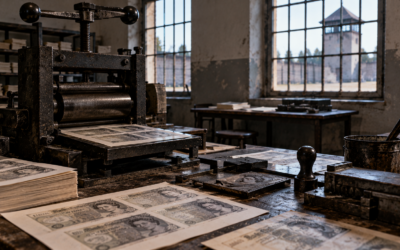
- Counterfeiting. Under “Operation Bernhard,” skilled prisoners at Sachsenhausen forged British banknotes and other documents for the SS, a state-run operation rather than a private-company one.
How the SS Itself Benefited
The SS was not only a middleman. It was a business.
- Leasing fees. Daily per-head charges to industry brought in large sums, which historians estimate at tens of millions of Reichsmarks a year by the later war years.
- SS-owned enterprises. DEST and other SS companies used prisoner labor directly, reducing their costs and feeding the SS’s ambitions as an economic power.
- Camp economy. Prisoners built and maintained the camp infrastructure for free, and the SS profited from confiscated property and from exploiting prisoners’ remaining belongings.
- Institutional power. Control of labor gave the SS leverage over the armaments industry and, with Speer’s ministry, competed with the SS for control of prisoners.
Corporate Responsibility After 1945
The postwar record is mixed and, in many cases, unsatisfying.
- Nuremberg Military Tribunals (1947 to 1948). Executives of Flick, IG Farben, and Krupp were tried, and several were convicted of crimes including participation in forced labour and the plunder of occupied territories. These were trials of individual industrialists and executives, rather than criminal convictions of the corporations themselves. Pohl was convicted in the WVHA trial and executed in 1951. But the US High Commissioner granted early releases in the early 1950s, and some convicted industrialists subsequently returned to influential business positions.
- Continuity. Many firms continued after the war with largely intact management. The brand names on the list above are still familiar today.
- Legal barriers. The 1953 London Debt Agreement postponed consideration of many Second World War reparations claims until a final settlement of reparations, and German courts in the 1950s and 1960s generally rejected forced labourers’ individual claims against companies, sometimes relying on the agreement as a legal barrier.
- Wartime damage compensation. General Motors is often named in this context. GM’s German subsidiary, Opel, produced vehicles for the German military, and GM subsequently pursued compensation claims concerning wartime damage to its German property. However, the details of those claims should not be confused with compensation for forced labour or treated as evidence of GM’s direct involvement at Sachsenhausen.
Compensation for Surviving Forced Laborers
For decades, most forced laborers received little or no compensation specifically for their forced labour. Early German compensation laws were aimed mainly at victims of political, racial, and religious persecution, and did not generally recognise forced labour alone as grounds for compensation, particularly affecting non-Jewish victims in Eastern Europe.
- 1950s to 1960s. Limited negotiated settlements were reached with a few companies. The best-known were with IG Farben, then in liquidation (1957), which agreed to pay DM 30 million, and Krupp (1959), which agreed to provide an initial DM 6 million, potentially rising to DM 10 million. These settlements primarily benefited eligible Jewish former forced laborers, with other agreements involving companies such as Siemens.
- 1990s. After the end of the Cold War, survivors in Eastern Europe could pursue compensation more effectively, although some earlier compensation arrangements had existed. US class action suits and international pressure forced the issue.
- 2000. Germany created the foundation “Remembrance, Responsibility and Future” (EVZ), funded with DM 10.1 billion, contributed in roughly equal shares by German industry and the federal government. Between 2001 and 2007, it paid approximately €4.4 billion to more than 1.66 million former forced laborers and their legal successors, with individual payments up to 15,000 DM for eligible concentration camp and ghetto prisoners and up to 5,000 DM for other qualifying categories.
By then, most of those who had been enslaved were elderly or dead. The payments were widely seen as symbolic rather than full restitution.
FAQs
- Did General Motors seek compensation for wartime damage to its German factories?
Yes. General Motors filed postwar claims concerning damage and losses involving its German subsidiary, Opel. These were property-related claims and should not be confused with compensation for victims of Nazi forced labour.
- Did companies pay the prisoners?
No. Companies paid the SS. The prisoners received nothing.
- Were all the big German firms involved at Sachsenhausen?
No. Many used forced labor elsewhere in the Reich. The firms with a documented link to Sachsenhausen are a smaller group, listed above.