When you llegar a Berlín, you have a practical idea: locate the Jewish Quarter, stroll around it, and get a proper understanding of it. But then you realize that the city doesn’t have a single well-defined area you can check off. The story is spread out over brass plaques in the road, lamp posts in a residential area, and a building that causes your stomach to drop before you work out why. This fragmentation is intentional. Berlin presents its history in fragments because that’s how it was lost.
Esta guía te muestra dónde buscar, qué leer primero y cómo moverte por estos lugares sin convertirte en el turista al que todo el mundo mira con recelo.
Start at your feet: the plaques on the pavement.
The first thing most visitors notice isn’t the museum but a small commemorative plaque embedded in the sidewalk outside a normal apartment block, naming someone who lived there and was persecuted.
Some older plaques carry a phrase that surprises visitors: that the person “sought refuge in Palestine.” People often stop and ask whether that is a mistake or a political statement. It is neither. Before 1948, the territory was widely known as Palestine, first under Ottoman administration and then under the British Mandate. Many German Jews who escaped in the 1930s went there, and the phrasing reflects the era’s vocabulary. Even a well known English language newspaper in Jerusalem carried the name Palestine in its title for years.
The takeaway from your trip should be to treat the plaques as reflections of the era in which they were made; since place names change and borders shift, the words engraved in stone tell you what people used to call their world when they had been driven out of it. Take your time, read the entire line, and don’t walk on the plaques just out of habit.
Understand what happened in the streets, not just the camps.
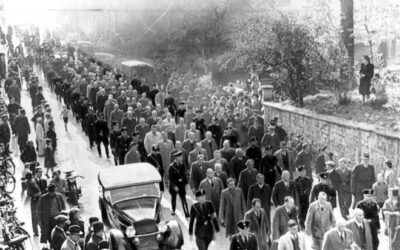
Most visitors arrive knowing the endpoint of this history. What Berlin does better than almost any city is show you the slow build. Consider the summer of 1935, when the first organized actions in the east of the city began in mid June. They were small and, at first, oddly gentle. Nazi agitators gathered outside several ice cream shops and shouted at customers. The crowds mostly pushed back, and people said things like “The Jews are human beings too” or “if something has to be done, let the government decide.”
Within two months, Jewish shops had been smeared with paint on five separate occasions. The word “Jew” was daubed on windows in paint that was very hard to remove, along with slurs and notices urging a boycott. Newspapers in Cologne then celebrated these “results,” claiming that customers were shifting away from Jewish shops. At a civil servants’ conference, a keynote speaker declared that the boycott should continue and that anyone unable to make a living would “leave of his own free will.”
Lee la secuencia dos veces y verás que nada se parece al capítulo final; parece ser el resultado de vandalismo, propaganda y presión administrativa, todo lo cual se permitió que sucediera gradualmente. Muchos visitantes abandonan Berlín afirmando que lo más perturbador que aprendieron fue que la atrocidad había sido precedida por años de incidentes que, para muchos ajenos a la situación, parecían ser problema de otros. Si quieres conocer la versión real y de primera mano de esta historia, sal a la puerta de cualquier tienda en Berlín e imagina la pintura secándose en el escaparate.
Want to understand what happened to Berlin’s Jewish community during the Nazi era? Read our blog on What Happened to Berlin’s Jewish Community Under the Nazis? for a deeper look at this devastating period in Berlin’s history.
The Jewish Museum Berlin: how to actually do it
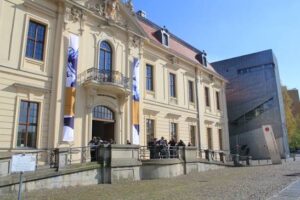
The Jewish Museum is the main attraction on a trip there and offers a good return for the effort. The building, designed by Daniel Libeskind, is well known for its sharp, broken layout. The arrangement of the space was determined by the addresses of the Jews who lived in Berlin, so the architecture is in a very real sense a map of absence. One does not need to grasp the geometry to sense it; the angles, the dead ends, and the inclined floors carry out the effect.
Aquí tienes un consejo sincero para viajeros:
No juzgues el museo solo por su exterior. Many visitors photograph the exterior, conclude that the architecture is the main interest, and then move through the site quickly. Another group claims that the area photographed most is, in fact, the one with the least architectural interest. The more worthwhile experience is inside, particularly in spaces deliberately designed to make you feel uncomfortable.
Ahorra tiempo para el Vacío de la Memoria. Este es el único espacio vacío del edificio Libeskind al que los visitantes pueden acceder. Contiene Shalekhet, o Hojas Caídas, del artista israelí Menashe Kadishman: aproximadamente 10.000 rostros recortados en acero y esparcidos por el suelo. Se invita a los visitantes a camina sobre ellos, and the sound is what people remember. Metal plates clang and rattle against each other in a narrow concrete room. It is loud, awkward, and deeply haunting, and that is intentional. Kadishman dedicated the work not only to Jews killed in the Shoah but to all victims of violence and war.
Go in without a camera agenda. People often write that this room is eerie and powerful in a way photographs cannot capture. Put the phone away for a few minutes and listen to your own footsteps.
The neighborhood memorial most tourists miss.
Away from the museum district, in a residential neighborhood, a memorial stands that does not look like a memorial at all. Signs mounted on lamp posts show images and the text of rules imposed on Jews step by step: restrictions on where they could shop, sit, travel, and work. It has been there since 1993.
Because the site is situated among regular buildings, you’ll see it when people walk their dogs or carry shopping bags. This has led to a frequent question among tourists: what do the local people think about it? When visitors photograph the signs, they sometimes get curious or even irritated reactions and wonder whether the memorial is controversial. The more likely explanation, though, is simple: residents pass by the signs every day and seldom take the time to look at them, so they notice when a stranger does. It’s less a judgment of the memorial than the typical expression a local gives a tourist.
The key point is this: when you go there, keep quiet, take only a few photographs, and let the signs speak for themselves. If you know some German, you can understand most of the text at once. If you don’t know German, there are translated versions of the signs, and it’s a good idea to look them up in advance, since the bureaucratic tone of the rules is the most disturbing aspect.
Una nota sobre el Memorial del Holocausto y las selfies
You can see visitors taking photographs at the principal monumento central, and many tourists find this rather unpleasant. If you prefer a more thoughtful visit, focus on places such as the Memory Void or the lamp post signs, which are designed to encourage silence rather than photos. You can visit the central memorial, but treat it as a site of mourning, not a backdrop.
Interested in how Berlin remembers the people who were persecuted and murdered? Read our blog on Stolpersteine: los pequeños monumentos conmemorativos to learn about these small but meaningful memorials found throughout the city.
The deeper context: Jewish emancipation in the 1840s
If you are reading this as part of a course or if you are interested in the origins of the story, you should look beyond the 1930s. Marx wrote his work On the Jewish Question in 1843 and published it in 1844. The period referred to in German history as the Vormärz was contradictory for the Jews; although real advances towards emancipation did take place, particularly in areas influenced by the Napoleonic Legal code, there were also setbacks, for example under Prussia, since Germany had not yet become a single country and rights differed from region to region.
También existía una fuerte presión para la asimilación. Muchos judíos cambiaron sus nombres, se convirtieron o se alejaron de sus tradiciones; el bautismo familiar de Marx es un ejemplo típico. Al mismo tiempo, disturbios como los de Hep Hep después de 1815 demostraron que la hostilidad aumentó precisamente en las zonas donde se debatía la emancipación. Historiadores como Jacob Katz han demostrado que el antisemitismo no fue simplemente una respuesta a agravios económicos.
Las décadas posteriores también son importantes, ya que en la década de 1880 se produjo la controversia sobre el antisemitismo en Berlín y surgieron movimientos organizados para revertir los derechos de los judíos, mucho antes del caso Dreyfus en 1894. Si desea leer algo antes de ir, podría considerar El gueto de Jacob Katz, el capítulo que abre la historia del sionismo sobre los judíos alemanes de Walter Laqueur, y las obras de Michael Brenner y Shulamit Volkov.
Por qué la historia comienza aquí
En Berlín se defendieron los derechos de la emancipación, se intentó la asimilación, se organizó la hostilidad y la propia ciudad sufrió las consecuencias. Si visitas las placas, lees las farolas y te paras en esa sala bulliciosa, comprenderás por qué la historia comienza aquí.
Frequently Asked Questions
- Why do some Berlin plaques say people “sought refuge in Palestine”?
Before 1948, the region was usually called Palestine, and in the 1930s a large number of German Jews went there. The phrasing reflects the naming conventions of that period and does not express a current political stance.
- What are the metal faces in the Jewish Museum, and why do they make noise?
They are Shalekhet, or Fallen Leaves, by Menashe Kadishman: about 10,000 steel faces on the floor of the Memory Void. Visitors walk on them, and the plates clang against each other, creating the sound the artist intended.
- Do locals mind visitors photographing the lamp post memorial?
Not necessarily. The memorial has stood since 1993, and residents pass it daily. Curious looks usually mean they have noticed a tourist, not that they object to the memorial.
- Why is the Jewish Museum building shaped so strangely?
Its plan follows the coordinates of the homes of Jews who lived in Berlin, turning the architecture into a map of absence.
- What was happening to German Jews around the time Marx wrote On the Jewish Question?
It was the 1840s, a period of mixed emancipation and reversal across German states, with strong pressure to assimilate and recurring anti-Jewish riots. Marx wrote in 1843 as part of a wider debate about whether and how Jews should receive equal rights.