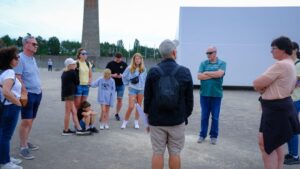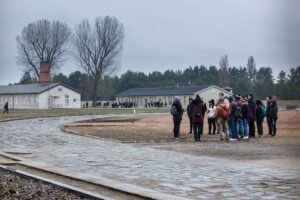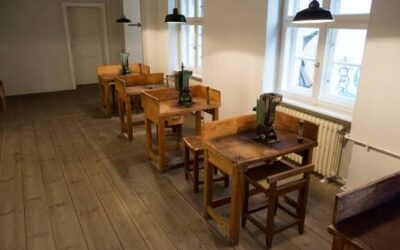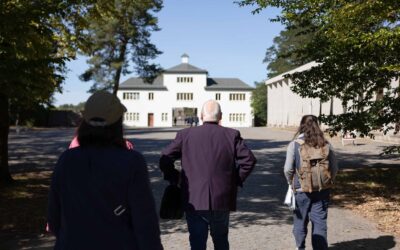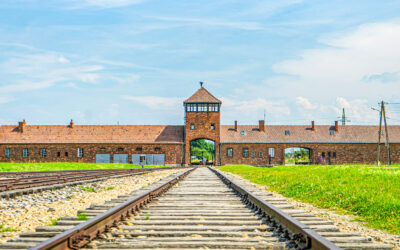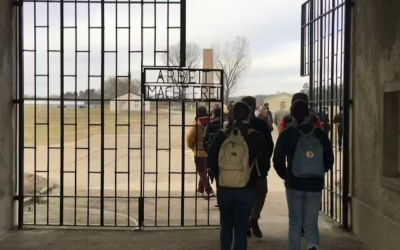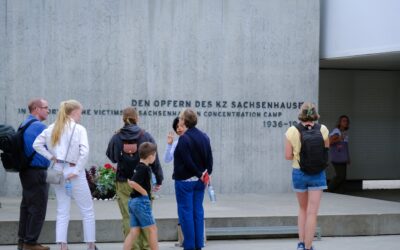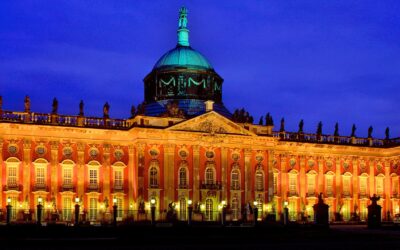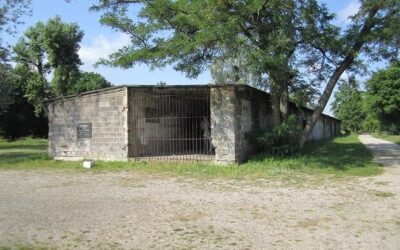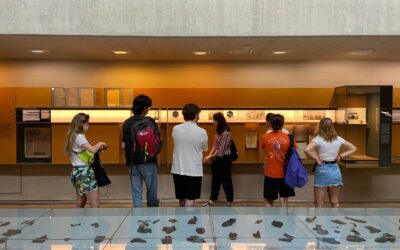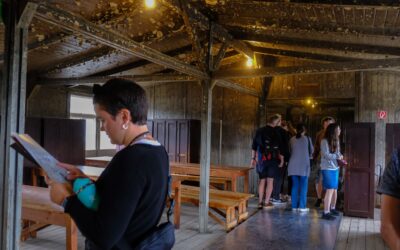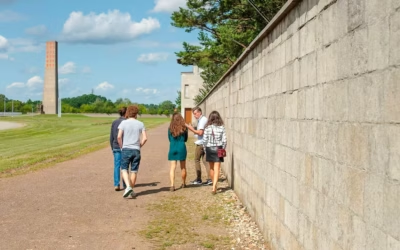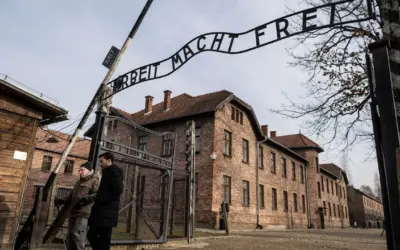
When you arrive in Berlin, you have a practical idea: locate the Jewish Quarter, stroll around it, and get a proper understanding of it. But then you realize that the city doesn’t have a single well-defined area you can check off. The story is spread out over brass plaques in the road, lamp posts in a residential area, and a building that causes your stomach to drop before you work out why. This fragmentation is intentional. Berlin presents its history in fragments because that’s how it was lost.
This guide shows you where to look, what to read first, and how to move through these places without becoming the tourist everyone quietly side eyes.
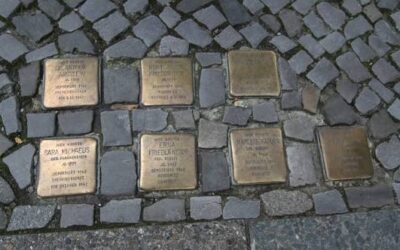
Start at your feet: the plaques on the pavement.
Pierwszą rzeczą, na którą zwraca uwagę większość zwiedzających, nie jest muzeum, lecz niewielka tablica pamiątkowa umieszczona na chodniku przed blokiem mieszkalnym, upamiętniająca osobę, która tam mieszkała i była prześladowana.
Some older plaques carry a phrase that surprises visitors: that the person “sought refuge in Palestine.” People often stop and ask whether that is a mistake or a political statement. It is neither. Before 1948, the territory was widely known as Palestine, first under Ottoman administration and then under the British Mandate. Many German Jews who escaped in the 1930s went there, and the phrasing reflects the era’s vocabulary. Even a well known English language newspaper in Jerusalem carried the Nazwa Palestine in its title for years.
The takeaway from your trip should be to treat the plaques as reflections of the era in which they were made; since place names change and borders shift, the words engraved in stone tell you what people used to call their world when they had been driven out of it. Take your time, read the entire line, and don’t walk on the plaques just out of habit.
Understand what happened in the streets, not just the camps.
Większość turystów przyjeżdża, znając kres tej historii. Berlin robi to lepiej niż prawie każde inne miasto, pokazując powolny rozwój wydarzeń. Rozważmy lato 1935 roku, kiedy w połowie czerwca rozpoczęły się pierwsze zorganizowane akcje we wschodniej części miasta. Były one niewielkie i początkowo dziwnie łagodne. Nazistowscy agitatorzy zebrali się przed kilkoma lodziarniami i krzyczeli na klientów. Tłumy w większości stawiały opór, a ludzie mówili: „Żydzi też są ludźmi” albo „jeśli coś trzeba zrobić, niech rząd zdecyduje”.
Within two months, Jewish shops had been smeared with paint on five separate occasions. The word “Jew” was daubed on windows in paint that was very hard to remove, along with slurs and notices urging a boycott. Newspapers in Cologne then celebrated these “results,” claiming that customers were shifting away from Jewish shops. At a civil servants’ conference, a keynote speaker declared that the boycott should continue and that anyone unable to make a living would “leave of his own free will.”
Read the sequence twice, and you’ll see that nothing in it resembles the final chapter; it appears to be the work of vandalism, propaganda, and administrative pressure, all of which were allowed to happen gradually. A great many visitors leave Berlin stating that the most disturbing thing they had learned was the fact that the atrocity had been preceded przez years of incidents which, to many on the sidelines, seemed like someone else’s problem. If you want the real, ground-level version of this history, step outside a small shop on any street in Berlin and picture the paint drying on the window.
Want to understand what happened to Berlin’s Jewish community during the Nazi era? Read our Blog on Co stało się ze społecznością żydowską w Berlinie pod rządami nazistów? for a deeper look at this devastating period in Berlin’s history.
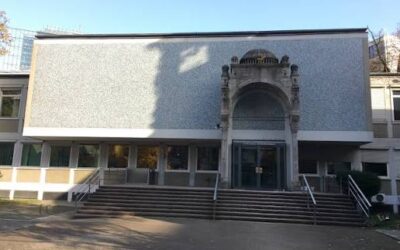
The Jewish Museum Berlin: how to actually do it
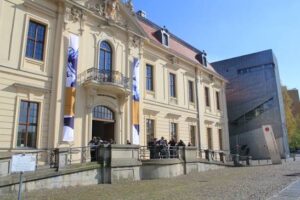
The Jewish Museum is the main attraction on a trip there and offers a good return for the effort. The building, designed przez Daniel Libeskind, is well known for its sharp, broken layout. The arrangement of the space was determined przez the addresses of the Jews who lived in Berlin, so the architecture is in a very real sense a map of absence. One does not need to grasp the geometry to sense it; the angles, the dead ends, and the inclined floors carry out the effect.
Here is the honest traveler advice:
Do not judge the museum przez its exterior alone. Many visitors photograph the exterior, conclude that the architecture is the main interest, and then move through the site quickly. Another group claims that the area photographed most is, in fact, the one with the least architectural interest. The more worthwhile experience is inside, particularly in spaces deliberately designed to make you feel uncomfortable.
Save time for the Memory Void. This is the one voided space of the Libeskind building that visitors can actually enter. It holds Shalekhet, or Fallen Leaves, przez the Israeli artist Menashe Kadishman: roughly 10,000 faces cut from steel and scattered across the floor. Visitors are invited to walk over them, and the sound is what people remember. Metal plates clang and rattle against each other in a narrow concrete room. It is loud, awkward, and deeply haunting, and that is intentional. Kadishman dedicated the work not only to Jews killed in the Shoah but to all victims of violence and war.
Go in without a camera agenda. People often write that this room is eerie and powerful in a way photographs cannot capture. Put the phone away for a few minutes and listen to your own footsteps.
The neighborhood memorial most tourists miss.
Away from the museum district, in a residential neighborhood, a memorial stands that does not look like a memorial at all. Signs mounted on lamp posts show images and the text of rules imposed on Jews step przez step: restrictions on where they could shop, sit, travel, and work. It has been there since 1993.
Because the site is situated among regular buildings, you’ll see it when people walk their dogs or carry shopping bags. This has led to a frequent question among tourists: what do the local people think about it? When visitors photograph the signs, they sometimes get curious or even irritated reactions and wonder whether the memorial is controversial. The more likely explanation, though, is simple: residents pass przez the signs every day and seldom take the time to look at them, so they notice when a stranger does. It’s less a judgment of the memorial than the typical expression a local gives a tourist.
The key point is this: when you go there, keep quiet, take only a few photographs, and let the signs speak for themselves. If you know some German, you can understand most of the text at once. If you don’t know German, there are translated versions of the signs, and it’s a good idea to look them up in advance, since the bureaucratic tone of the rules is the most disturbing aspect.
A note on the Holocaust Memorial and selfies
You can see visitors taking photographs at the major central memorial, and many tourists find this rather unpleasant. If you prefer a more thoughtful visit, focus on places such as the Memory Void or the lamp post signs, which are designed to encourage silence rather than Zdjęcia. You can visit the central memorial, but treat it as a site of mourning, not a backdrop.
Interested in how Berlin remembers the people who were persecuted and murdered? Read our Blog on Stolpersteine: Małe pomniki to learn about these small but meaningful memorials found throughout the city.
The deeper context: Jewish emancipation in the 1840s
If you are reading this as part of a course or if you are interested in the origins of the story, you should look beyond the 1930s. Marx wrote his work On the Jewish Question in 1843 and published it in 1844. The period referred to in German history as the Vormärz was contradictory for the Jews; although real advances towards emancipation did take place, particularly in areas influenced by the Napoleonic Prawny code, there were also setbacks, for example under Prussia, since Germany had not yet become a single country and rights differed from region to region.
There was also strong pressure to assimilate. A number of Jews altered their names, converted, or moved away from their traditions; Marx’s family baptism is a typical case in point. At the same time, riots such as the Hep Hep disturbances after 1815 showed that hostility increased in the very areas where emancipation was being discussed. Historians like Jacob Katz have proved that antisemitism was not simply a response to economic grievances.
The later decades are also important, since the 1880s saw the Berlin antisemitism controversy and the emergence of organized efforts to reverse Jewish rights, long before the Dreyfus affair in 1894. If you’d like to read some material before you go, you might consider Jacob Katz’s Out of the Ghetto, the chapter opening Walter Laqueur’s history of Zionism on German Jewry, and the works of Michael Brenner and Shulamit Volkov.
Why the story starts here
In Berlin, arguments for emancipation were made, assimilation was attempted, hostility was organized, and the city itself absorbed the consequences. If you visit the plaques, read the lamp posts, and stand in that noisy room, you will realize why the story begins here.
Często zadawane pytania
- Why do some Berlin plaques say people “sought refuge in Palestine”?
Before 1948, the region was usually called Palestine, and in the 1930s a large number of German Jews went there. The phrasing reflects the naming conventions of that period and does not express a current political stance.
- What are the metal faces in the Jewish Museum, and why do they make noise?
They are Shalekhet, or Fallen Leaves, przez Menashe Kadishman: about 10,000 steel faces on the floor of the Memory Void. Visitors walk on them, and the plates clang against each other, creating the sound the artist intended.
- Do locals mind visitors photographing the lamp post memorial?
Not necessarily. The memorial has stood since 1993, and residents pass it daily. Curious looks usually mean they have noticed a tourist, not that they object to the memorial.
- Why is the Jewish Museum building shaped so strangely?
Its plan follows the coordinates of the homes of Jews who lived in Berlin, turning the architecture into a map of absence.
- What was happening to German Jews around the time Marx wrote On the Jewish Question?
It was the 1840s, a period of mixed emancipation and reversal across German states, with strong pressure to assimilate and recurring anti-Jewish riots. Marx wrote in 1843 as part of a wider debate about whether and how Jews should receive equal rights.