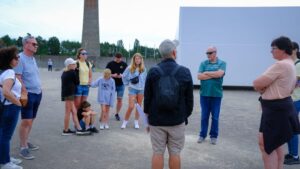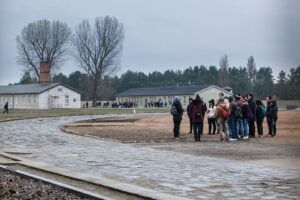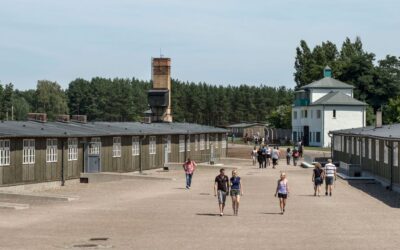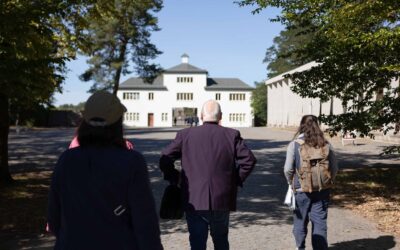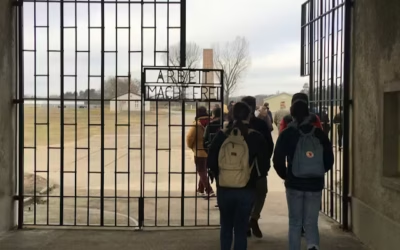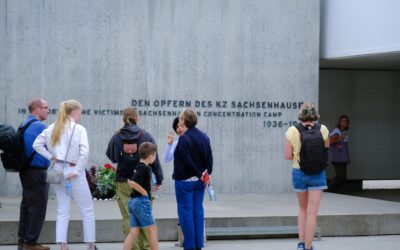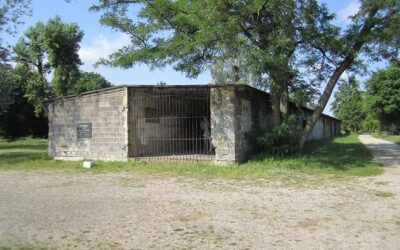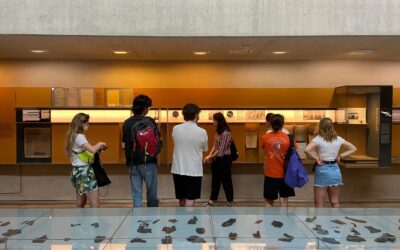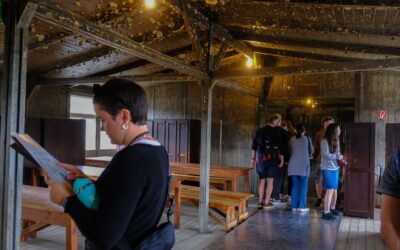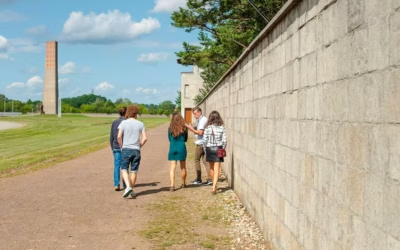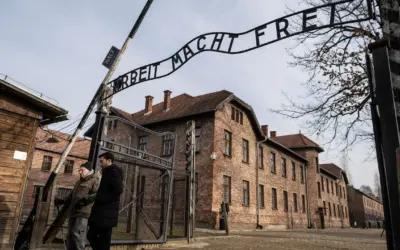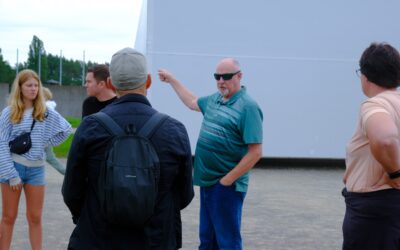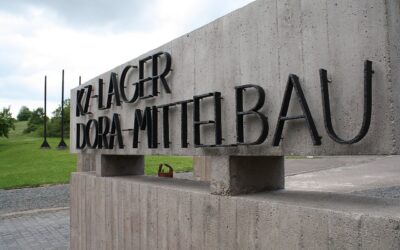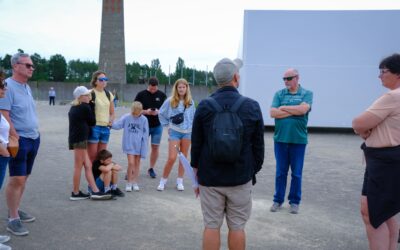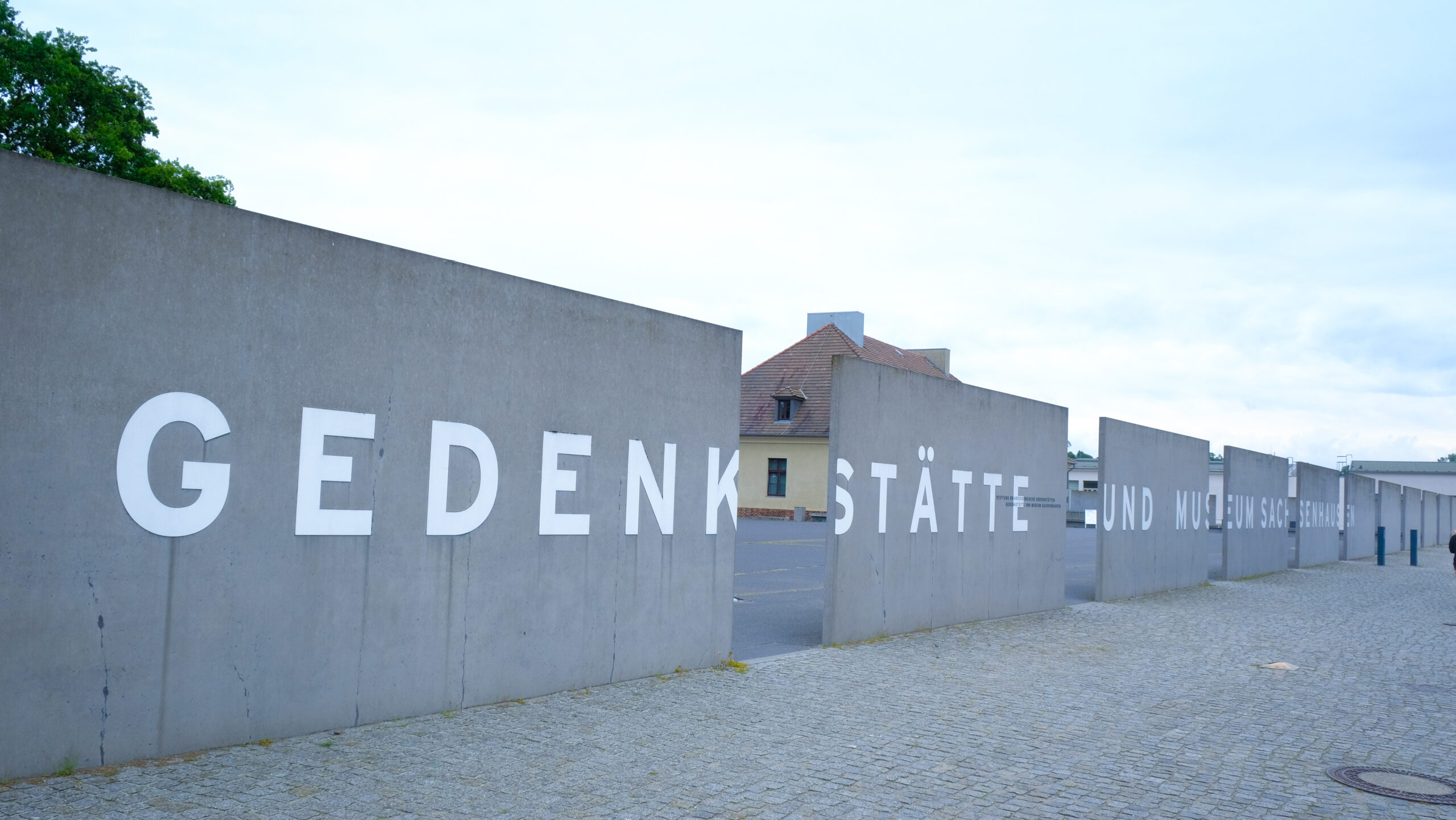
Standing at the gate in Oranienburg, just north of Berlin, a city whose Nazi-era history you can Ontdekken on a free Berlin walking tour, almost every visitor asks the same quiet question.
The short answer is that they were all three. The longer answer is more unpleasant than the accounts given door either side. To explain who kept guard at Sachsenhausen, how the guard system functioned, and what the evidence reveals about the decisions these people made, this guide draws on trial records, survivor testimony, and historical research.
The Camp and Its Place in the System
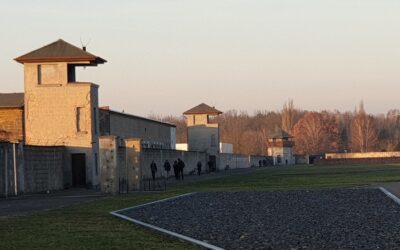
Sachsenhausen opened in 1936 and was designed as a showpiece. Its triangular layout placed the main gate, with the guard tower above it, at the apex, so a single position could, in theory, observe the entire prisoner area. Its location beside Berlin also mattered. In 1938 the Inspectorate of Concentratiekampen, the office that ran the entire camp system, moved to Oranienburg, and it stayed there until 1945. Sachsenhausen was therefore both a camp and a training ground and administrative center for the whole system. Staff was formed here, and methods devised here were carried to other camps.
Bewakers, kamppersoneel en bevelhebbers: drie verschillende lagen
Visitors often use the word “guard” for everyone in an SS uniform. The camp’s organization was more structured than that.
De commandant en Kommandantur. The commandant held overall authority and answered to the Inspectorate, and after 1942 to the SS Economic and Administrative Main Office (WVHA), which absorbed the Inspectorate. Under him, the camp administration was divided into departments: the commandant’s office and adjutant, the Political Department (the Gestapo’s branch inside the camp), the protective custody camp, administration, and the camp physician. Commandants at Sachsenhausen included Karl Otto Koch, Hans Helwig, Hermann Baranowski, Walter Eisfeld, Hans Loritz, and, in the final years, Anton Kaindl.
The protective custody camp staff. Dit was de groep gevangenen die dagelijks bijeenkwam. Schutzhaftlagerführer ran the prisoner compound, assisted door a Rapportführer, who handled roll calls and head counts, and door block leaders (Blockführer), SS non-commissioned officers who supervised individual barracks and were often responsible for beatings, punishments, and murders inside the compound.
De bewakingstroepen. The guard battalion, drawn from the SS Death’s Head units (Totenkopfverbände), was the armed force that secured the perimeter, manned the towers, and escorted prisoners outside the wire. In the camp’s early years, a Death’s Head regiment was stationed at Oranienburg. These men were organized as soldiers, with barracks and military drill, and were organizationally distinct from, but part of the same SS Death’s Head structure as, the staff who managed prisoners inside the compound.
In fact, these ranks overlapped because they were all part of the same organization and wore the same uniform. However, the distinction matters when assigning responsibility: a tower sentry, a block leader, a Gestapo interrogator, and a commandant had different roles, different levels of discretion, and different exposure to what happened inside.
Recruitment and Training
The Death’s Head system was created in the 1930s door Theodor Eicke, who established it at Dachau before extending it to other camps. The first people to join were mostly young men, often from modest socioeconomic backgrounds, and they did so to earn a steady salary, gain status, and advance their careers. They underwent training that included military exercises as well as ideological instruction. Prisoners were considered to be enemies of the state and were taught that displaying sympathy amounted to a sign of weakness. Eicke intentionally emphasized severity, hoping cruelty would become the norm and that the guards would form a unified group through their shared involvement.
That early picture changed once war began. Many of the original Death’s Head men were drawn into the Waffen-SS field formations, and the camps needed replacements. The guard force was then filled with older members of the Allgemeine SS, men judged unfit for the front, ethnic Germans from occupied territories, and later other personnel transferred into concentration camp guard service. In the last phase of the war, men transferred from other services were added as well. As the war progressed, the SS increasingly relied on personnel who did not meet its earlier recruitment standards.
This also undercuts a postwar myth. Former SS leaders tried to separate the “honorable” fighting Waffen-SS from the camp guards. In reality, the two shared an organization, an oath, and often the same personnel, and personnel transfers connected guard service with front-line formations.
Wat de wachtdienst precies inhield
Het dagelijkse werk van de bewakingsdienst was erop gericht het kamp gesloten en productief te houden.
Towers and perimeter. Around the camp, sentries stood in towers, supported door an electrified fence, a strip of land in front of the fence, and a ditch and a wall. Any attempt to enter the strip was regarded as an attempt to escape, and the sentries were instructed to fire without warning. In some cases the deaths were staged or induced: the prisoners were driven towards the line or asked to retrieve objects nearby, and then shot ‘while trying to escape’.
Escorts and work details. Prisoners were organized into work details (Kommandos) die het kamp verlieten om te werken in steenfabrieken, op bouwplaatsen en in wapenfabrieken. Buiten het prikkeldraad vormden bewakers een bewegend cordon om hen heen. De steenfabrieken en de wapenproductie die aan Sachsenhausen waren verbonden, behoorden tot de dodelijkste taken. Bewakers werden beloond met extra verlof voor het neerschieten van 'voortvluchtigen', wat een stimulans creëerde om te doden.
Roll calls. The daily headcount (Appell) was a key element in the system of control. Prisoners would stand on the parade ground, sometimes for hours and regardless of the weather, until the totals agreed. Roll call served not only as an administrative procedure but also as punishment and a way to exhaust the prisoners, and the guard and staff carried it out.
Moordoperaties. Bewakers en stafleden waren betrokken bij de massale misdaden in het kamp. In de herfst van 1941 werden duizenden Sovjetkrijgsgevangenen in Sachsenhausen vermoord, de meesten door een schot in de nek in een speciaal daarvoor gebouwde installatie: dit vereiste organisatie, personeel en samenwerking binnen het hele kamp. In april 1945, toen de Sovjettroepen naderden, werden tienduizenden gevangenen onder bewaking gedwongen tot dodenmarsen, waarbij velen onderweg werden gedood of voor dood achtergelaten.
Movement Between Camps and Roles
Het SS-kampensysteem was geen verzameling geïsoleerde locaties. Het was een carrièrestructuur, en personeel doorliep deze structuur.
Mensen trainden in één kamp. were sent to open or reorganize others. Because the Inspectorate was based at Oranienburg, Sachsenhausen became an especially important central camp. Rudolf Höss, who later became the commandant of Auschwitz, worked at Sachsenhausen in the late 1930s before transferring to another camp, a pattern which was typical of the way experience and methods were passed on. Officers moved between the camp administration, the guard units, the Inspectorate and the field formations. During the war, men also moved from the guard service to Waffen-SS combat units and vice versa, with Waffen-SS personnel also transferred to Sachsenhausen’s SS Death’s Head Battalion to serve as guards.
Deze mobiliteit heeft twee gevolgen voor het concept van verantwoordelijkheid. Enerzijds heeft het systeem deze praktijken overgenomen in plaats van ze op lokaal niveau te ontwikkelen. Anderzijds hebben individuen wel degelijk van functie gewisseld, waardoor het mogelijk werd om te beantwoorden of iemand een bepaalde functie kon verlaten, in plaats van dit als een puur hypothetische vraag te beschouwen.
Individual Responsibility and the Evidence on Refusal
Na de oorlog, the usual defense was that the guards had no alternative: they could either carry out the killings or face the firing squad. However, historians have examined this argument in light of the evidence and found it unsupported. Scholars who have studied the Holocaust have found no documented case of a German soldier, SS member, or policeman being executed specifically for refusing an order to murder civilians or prisoners. This does not prove that such an execution never occurred, but the available evidence does not support the claim that execution was the inevitable consequence of refusal. It doesn’t mean that opting out had no consequences; people who refused to take part might still be subjected to harsh treatment by their superiors, see their careers damaged, feel social pressure from their comrades, or be assigned to less comfortable or more dangerous tasks, for example, by being sent to the front. Yet documented cases suggest that the consequences of refusing to participate in killings were generally less severe than execution.
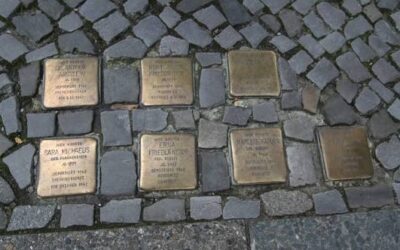
A documented example comes from Stutthof, not Sachsenhausen. Erna Beilhardt served as an SS female guard at Stutthof in 1944 before voluntarily leaving her position. Historian Marcin Owsiński has examined her case using historical records and testimony. At the first Stutthof trial in 1946, she received a five-year prison sentence, while several other defendants were sentenced to death and executed in July 1946. Her decision to leave guard service was an important factor in how her case was assessed. However, her experience should not be taken as proof that all concentration camp guards could resign without consequences. It illustrates an exceptional documented case rather than a general pattern.
It is honest to say that neither the simple explanations nor the obvious ones apply. While not all the guards were sadists, the records do show a great deal of sadism, as testified door the survivors and door other SS men. Furthermore, it is not true that everyone simply carried out orders with no other option. The system functioned because thousands of people made a series of small decisions, one after another, to remain and carry out their duties.
Na de oorlog
Most Sachsenhausen guards were never held to account. Many lower-ranking men dispersed into civilian life, some under pretenses, and few were prosecuted compared with those who served.
In 1947, a Soviet military tribunal tried former camp staff, including commandant Anton Kaindl, and handed down severe sentences. Later, West German courts convicted former staff members, including Gustav Sorge and Wilhelm Schubert, who received life sentences.
Deze gevallen waren uitzonderingen. Veel mannen die het kamp bewaakten en bestuurden, leefden de rest van hun leven zonder proces, en de kloof tussen de omvang van de misdaden en het aantal veroordelingen maakt zelf deel uit van de geschiedenis.
How to Stand in That Yard Without Flattening It
Whenever you go there, try to avoid simple explanations. The guards were not a distinct species of monster, and they had not been turned into helpless tools. They were men and certain women who had joined an organization set up with the aim of making cruelty commonplace. Although some had opportunities to refuse certain duties, request transfers, or leave their posts, documented cases of doing so were rare, and most remained in their roles.
Veelgestelde vragen
- Waren de bewakers van Sachsenhausen dezelfde als de kampleiding?
Nee. De bewakingstroepen bewaakten de perimeter en escorteerden de gevangenen, terwijl het kamppersoneel, waaronder de leidinggevenden van de afdeling beschermende bewaring, de blokleiders en de politieke afdeling, de gevangenen binnen het kamp beheerde en controleerde. Beiden vielen onder de commandant en behoorden tot dezelfde organisatie.
- Waar kwamen de bewakers vandaan?
In de beginperiode bestond de strijdmacht voornamelijk uit jonge SS-vrijwilligers die getraind werden volgens het Doodskopsysteem. Naarmate de oorlog vorderde, bestond de eenheid steeds meer uit oudere SS-reservisten, mannen die ongeschikt waren voor het front, etnische Duitsers uit bezette gebieden en buitenlandse hulptroepen.
- Kan een bewaker vertrekken of om overplaatsing vragen?
In some cases, yes, but very few did. People who refused to comply could face consequences such as damage to their careers, harsh duty, or being sent to front-line service, but historians have found no documented cases of German soldiers, SS members, or policemen being executed specifically for refusing to participate in the murder of civilians or prisoners. This does not establish that such executions never occurred. Documented resignations, such as that of Erna Beilhardt at Stutthof, were rare.
- Waarom was Sachsenhausen zo belangrijk binnen het concentratiekampsysteem?
Het lag naast Berlijn en huisvestte vanaf 1938 de Inspectie van Concentratiekampen. Het functioneerde dus zowel als kamp als commandopost waar personeel werd opgeleid en beleid werd gecoördineerd.
- Werden de bewakers na de oorlog gestraft?
Een minderheid wel. Een Sovjet-tribunaal berechtte in 1947 hoge functionarissen, en West-Duitse rechtbanken veroordeelden later enkele lagergeplaatste personeelsleden, maar de meeste bewakers werden nooit vervolgd.