On your way to the bakery, thinking about nothing in particular, you notice a small piece of brass embedded in the pavement. Next to it, someone has left a tealight. There are no signs and no crowd, merely a Nombre, a birth year, and a date that causes your stomach to drop.
Si alguna vez te has detenido en el middle of a Berlin sidewalk and wondered who lit that candle, whether you are allowed to touch the stone, or why the one next door has nothing on it, this guide is for you. These are the questions people who live with Stolpersteine actually ask, and the answers are more practical and more surprising than most visitors expect.
What You Are Actually Looking At
A Stolperstein is a concrete cube about ten centimeters wide, with a brass plate on top. The plate includes the person’s Nombre, year of birth, and what happened to them: deportation, arrest, flight, or death. The stone is placed in the acera frente a la última casa where the individual chose to live.
The term in German translates as “stumbling stone”, though the stumbling involved is not a physical one. It is a kind of stumbling that affects the eyes and one’s conscience: you have to bend your head to read the inscription, and in that moment you show respect to the person. The victims listed are Jews, Roma people, political opponents, LGBT+ individuals, and Jehovah’s Witnesses. Gunter Demnig started the project in the 1990s, and there are now over 100,000 such stones in about thirty countries; this has made it the largest decentralized memorial in the world.
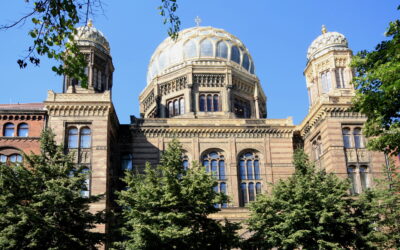
Want to learn more about what survived the destruction of Berlin’s Jewish community? Read our Blog on Nueva sinagoga: lo que sobrevivió to Explorar the synagogue’s history and what remains today.
The Candle Mystery: Who Lights Them?
Here is the part locals get asked about most. Someone in a building on a busy block sets out a candle beside the stone out front, yet most of the other stones on the street stay dark. Was it the caretaker? A kind neighbor? A secret society?
The truth is that no one is in charge and everyone takes responsibility; no central body distributes the candles. Individuals carry out this task: a careful Hausmeister, a resident who has looked into the person’s background, a family that regards it as a yearly tradition. Some people sponsor stones close to them and take them on, becoming what is known as a Putzpate, a cleaning patron, while others walk a circuit of their own neighborhood Cada otoño, se reúnen con amigos, puliendo cada piedra que encuentran y dejando flores.
The date matters. Candles and flowers cluster around 9 November, the anniversary of the 1938 Kristallnacht pogroms. That is also why Germany doesn’t celebrate reunification on that date. If you see tealights on Prenzlauer Allee one evening, then again in Kreuzberg the next day, you are watching the city remember in real time. The other date to watch is 27 January, the international day for remembering Holocaust victims.
¿Puedes limpiarlos? Sí, y te animamos a hacerlo.
One of the most common worries is whether polishing a stone will offend someone. It will not. People who have worked with the project say it is fine, and that stones on busy paths stay bright from foot traffic alone. The ones on quiet side streets are the ones that go dull and blend into the cobbles, especially in winter.
If you’d like to offer some help, look up “Stolpersteine putzen”. The first result is a cleaning guide issued por the foundation that incorporates the artist’s own suggestions, and it also includes a demonstration video. The fundamentals are straightforward: brass polish, a soft cloth, and water. It’s a good idea to have a small kit with you and to use it each time you come across a stone that has turned dark. Those who have cleaned an entire neighborhood say no one reacts at all, and sometimes a stranger even thanks you.
Is It Disrespectful to Step on Them?
This debate never quite ends. Some people feel a pang when they step on a Nombre. Others argue that the point is that the stones live in the walking surface of ordinary life, and that being trodden on keeps them polished and visible.
The Zentralrat der Juden, with the advice of rabbis, has made a public statement saying that stepping on the stones is all right since they are not graves and, if such walking helps to keep the memorial alive, that can be considered a form of care. In any case, many visitors establish their own personal ritual. They walk around, stop for a moment, or read the Nombre out loud. No one will criticize you for whatever choice you make.
Why Some Streets Have Dozens and Others Have None
Con frecuencia, la gente observa que una zona tiene muchas piedras mientras que la siguiente solo tiene una, y concluye que el registro está incompleto. En general, el registro está incompleto, pero no por negligencia.
Muchas familias se oponen a la colocación de una lápida. Dado que la idea de que un nombre quede grabado en el suelo, donde podría dañarse o desfigurarse, resulta inaceptable para algunos, no todas las víctimas reciben una. Además, los propietarios deben dar su consentimiento para que se coloque una lápida frente a sus edificios, y en algunos casos se niegan. Por otro lado, se siguen añadiendo nuevas lápidas. Quienes han pasado por el proceso afirman que la fundación gestiona las solicitudes como una pequeña organización sin ánimo de lucro y que muchas solicitudes provienen de alumnos que investigan a una familia en particular. Se informa que la lista de espera dura unos cinco años, y una sola lápida suele costar unos 120 euros, aunque el precio varía según el año y el país.
Si alguna vez te preguntas si una piedra nueva y brillante acaba de aparecer en un lugar por donde has caminado durante meses, probablemente tengas razón. Guijarros frescos, rosas y una lámpara alrededor de un plato brillante suelen indicar una instalación reciente, a menudo con familiares presentes.
¿Te interesa otra historia de resistencia en Berlín? Lee nuestro blog sobre La protesta de Rosenstraße: Cuando los berlineses protestaron contra la deportación de familiares judíos. to learn about this remarkable protest.
The Uncomfortable Parts
A good guide does not pretend the project is beyond argument. Three things come up.
Theft. Stones have been stolen in Berlin, and the reaction from residents was sharp: people described it as stepping again on people who were already dead. Stolen stones are usually replaced, and the community response can be as visible as the original memorial.
The trademark question. “Stolpersteine” is a registered mark, and the stones are meant to be made and laid through Demnig’s workshop, now a foundation. That has sparked a long conversation in Germany about money, given the tens of thousands of stones laid and the millions of euros that have passed through. A handmade brass stone that a maker travels to install is not cheap to produce, and the cost per stone strikes many people as fair. The critics point out that a memorial tied to a genocide raises hard questions about who profits. The controversy sharpened when a group in Apeldoorn planned cheaper marble alternatives, and the artist accused them of copying his idea. Expect strong opinions if you bring it up at the dinner table.
Who is missing. Not every famous Nombre has one. Walter Benjamin lived in Wilmersdorf before going into exile, but his Berlin marker is a memorial plaque on the building at Prinzregentenstraße 66, not a stone. People sometimes point to Wesel for a stone in his Nombre. This reminds us that plaques and stones serve different purposes.
How to Do This Well as a Visitor
Slow down on any residential street in Berlin, and look down more than you usually would. Read the whole inscription, then do the arithmetic on the dates. If a candle is lit, leave it as you found it. If the stone is grimy, clean it. If you are lucky enough to pass a laying ceremony, stay a moment. Families travel from other countries to attend, and passersby who stop and watch are often welcomed into the conversation.
One traveler described attending a ceremony in October 2023 for a father and grandmother, and said strangers stopped to watch and talk. That is the project’s whole design. It does not ask you to visit a museum. It puts one person’s Nombre in the street and trusts you to notice.
Preguntas frecuentes
- Who sets out the candles and flowers on Stolpersteine?
No official body does. Residents, caretakers, sponsors, relatives and volunteer groups all do it. Most of it happens around 9 November and 27 January.
- ¿Puedo limpiar un Stolperstein que me encuentre?
Yes. The foundation publishes cleaning instructions, and anyone can become a Putzpate. Use brass polish, a soft cloth, and water.
- Are new Stolpersteine still being laid?
Yes. Estimates run to hundreds each month across Europe. A small nonprofit handles requests, and people often report waits of around five years.
- Is it disrespectful to walk over one?
The Zentralrat der Juden has said stepping on them is acceptable, since they are not graves. Many people choose to walk around or pause anyway, and both are fine.
- ¿Por qué no hay un Stolperstein para Walter Benjamin en Berlín?
Berlin marks him with a memorial plaque at Prinzregentenstraße 66, where he lived in Wilmersdorf. A stone in his Nombre is reported in Wesel.