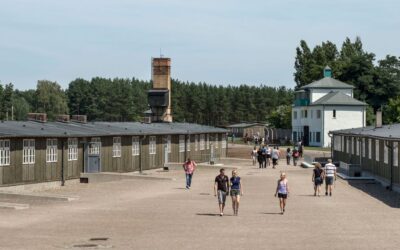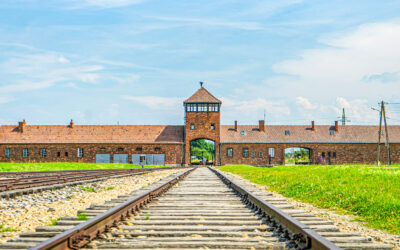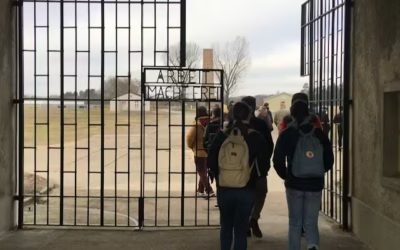
Stand in front of the famous chart of camp badges, and it looks like a clean, bureaucratic system: a row of colored triangles, each labeled, each meant to tell you exactly who a prisoner was. It is easy to read it like a legend on a map. The uncomfortable truth, which historians keep pointing out, is that the chart tells you what the SS planned, not always what happened on the ground at camps like Sachsenhausen. Here is what the colors meant, what they did to the people wearing them, and where the neat chart falls apart.
The Short Answer
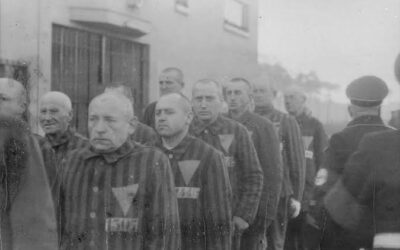
Prisoners wore an inverted triangle of fabric sewn onto the left side of their jacket and the right trouser leg, along with their number. The color named the supposed reason for their imprisonment:
- Red: political prisoners
- Green: career criminals
- Blue: emigrants
- Purple: Jehovah’s Witnesses
- Pink: men persecuted as homosexuals
- Black: “asocials,” a catch all label for people the regime called work shirkers
Jewish prisoners wore an additional yellow triangle. Placed under or over their category triangle, it formed a six pointed Star of David. A Jewish communist, for example, wore red and yellow together.
Prisoners from outside Germany also carried a letter inside the triangle: the first letter of their country’s German שֵׁם. A “P” stood for Polen, meaning Poland, and a “T” stood for Tschechoslowakei, meaning Czechoslovakia.
Where the System Came From
No one conceived the entire system all at once. Between 1935 and 1936, individual commandants started requiring new arrivals to wear badges indicating the supposed reason for their arrest. It wasn’t until the winter of 1937 and 1938 that the practice was made standard in all the camps and that the SS introduced colors to divide the prisoners into groups.
The sorting process was עַל יְדֵי no means impartial. The SS used the categories to establish a hierarchy, which was intentionally cruel. עַל יְדֵי pitting groups against one another, the daily struggle for survival became even harder. A prisoner in a “better” category might be assigned a slightly less harsh work detail, whereas someone in a disliked category could be picked on עַל יְדֵי guards and other prisoners.
The Question Almost Nobody Answers: What About People in Two Categories?
This is the puzzle that sends many readers digging. If you were a Roma man who was also a convicted criminal, or a communist who was also gay, which triangle did you get?
The general answer is simple. People were labeled for the reason they were arrested. Arrested for political activity, you got red. Arrested under Paragraph 175, the German law criminalizing sex between men, you got pink. The only reliable add-on was the yellow triangle for Jewish prisoners, which was combined with whatever the base color was, and which marked them for the harshest treatment.
Everything beyond that is murkier than the chart suggests. The chart includes bars and extra symbols that look like a layered coding system: markers for repeat offenders, a special symbol for race defilers, a brown armband, a triangle for members of the armed forces, and a circle with a red dot for suspected escapees. The trouble is that evidence of broad use has not been found for several of these. Historians have photographs, testimony, and surviving artifacts for the basic colored triangles and the double triangle for Jewish inmates. For the repeater bars, the race defiler badge, the brown armband and the armed forces triangle, the record goes quiet. There are even reports that in some camps, escape suspects had a target painted on their back instead of wearing the circle with the red dot.
When asked if a prisoner received a new color every time they were rearrested, the straightforward reply is that we do not have strong evidence to show that such a system of layered colors was in operation throughout the camp network. It was mostly the basic triangle together with an additional one for Jews.
Want to understand who was imprisoned at Sachsenhausen for political reasons? Read our בלוג on Political Prisoners at Sachsenhausen: Who Were Hitler’s Opponents? to learn more about political persecution at the camp.
Why the Famous Chart Misleads
It is worth casting doubt on the single image so many people hold, since that table is associated with Dachau and represents the 1930s, when the camp system was still small, and the paperwork had only just been created. At the time, strict compliance with the written rules was the most reasonable course of action.
Three problems stand out:
- The English captions contain errors. Take the blue triangle, labeled “emigrants.” In practice, it was used almost exclusively in Mauthausen, and chiefly for Germans who had fought on the Republican side in the Spanish Civil War. It was not a symbol for forced laborers, which is a common misreading.
- המערכת התרחבה מהר מדי. The number of people in the camp increased in 1938, once again in 1940, and once again in 1942, until it reached over 500,000 prisoners. When the numbers got that large, the detailed sorting rules gave way to a simpler system: a triangle to indicate the reason for arrest and a yellow badge for Jews.
- Rules and reality were different things. It was officially against the rules for the guards to beat the prisoners, yet the beatings still took place. The written regulations within the camp system stated intent rather than practice.
If you want to understand Sachsenhausen specifically, hold the chart loosely. It is a starting point, not a description of every barracks.
The Pink Triangle: Persecution That Did Not End in 1945
The pink triangle is a color with a special afterlife. Prior to 1933, Berlin possessed a visible gay culture, with, according to various sources, around 100 establishments catering to LGBT people in the city. The Institute for Sexual Research, founded עַל יְדֵי Magnus Hirschfeld in 1919, was a center for research and support. In May 1933, the Nazis carried out a raid on it and destroyed more than 20,000 books from its library.
Afterward, Paragraph 175 was enforced more severely. It is estimated that between 5,000 and 15,000 men were tried and convicted. A large number of them were sent to camps, where they could be segregated, subjected to medical experiments including castration, and worked to death. There are also accounts of mass killings of gay prisoners at the Klinkerwerk brickworks, a harsh subcamp of Sachsenhausen, in 1942. However, exact figures from that period are difficult to establish, so treat any precise total with care.
כאשר שוחררו המחנות, אסירים רבים מהמשולש הוורוד did not walk free in the same way. Some were made to finish sentences handed down under Nazi-era law. Survivors were not recognized or compensated. Paragraph 175 was not fully repealed in Germany until 1994, and the German government pardoned the men convicted under the Nazi-era application of the law in 2002.
There is also a divided Germany footnote worth knowing. Persecution under Paragraph 175 ended significantly earlier in East Germany, and where it did occur, it relied on the older pre-Nazi wording. In West Germany, the harsher Nazi version of the law stayed in force far longer. Anyone writing or reading about this period should specify which Germany they mean.
A Note on Uniforms Versus Badges
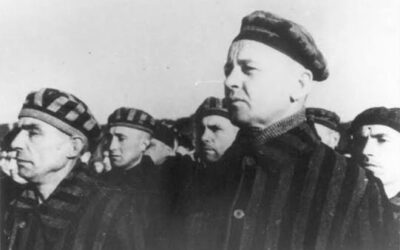
If you’ve looked at photographs of striped clothing and have been wondering about the link between them, then the stripes and the triangles are entirely separate. Striped uniforms have, in many places and at various times, been designed so that prisoners can be immediately distinguished from both guards and civilians, particularly when working outside the prison walls or in the event of an escape. On top of that, they used colored triangles as an additional means of identification. Nowadays, German prisons look entirely different from this system. Inmates usually wear their own clothes, and the approach is based on the idea that prison should protect society and aid rehabilitation, not humiliate.
Want to learn more about the experiences of Soviet prisoners at Sachsenhausen? Read our בלוג on Soviet Prisoners of War at Sachsenhausen: What Happened to Them? for a closer look at their history.
How to Read These Symbols Responsibly
If you are researching for a class, a novel, or a visit to a memorial, a few habits help:
- Treat the base triangle as reliable, and treat the add-on symbols as uncertain unless a source documents them for a specific camp and year.
- Check which camp and which year a chart comes from before generalizing.
- Remember that each triangle sat on a person. The categories were the SS’s invention, and they often did not match how prisoners understood themselves.
Frequently Asked Questions
- What did a pink triangle mean on a camp uniform?
It marked a man held under Paragraph 175 as a homosexual. Wearers were singled out for especially brutal treatment, often housed apart from other prisoners, and some were subjected to medical experiments, including castration.
- What if a prisoner belonged to more than one group, such as being a communist and gay?
Generally, the badge matched the reason for arrest. A man arrested for political activity wore red, even if he was also gay. The documented exception is Jewish prisoners, who wore the yellow triangle in addition to their category color.
- Were repeat offenders given extra colored bars?
The chart shows repeater symbols, but historians have found very little evidence they were used on a broad scale. If they appeared at all, it was likely in a few camps and in small numbers.
- What did the letters inside the triangles stand for?
They indicated nationality using the first letter of the German country שֵׁם. “P” meant Polen (Poland), “T” meant Tschechoslowakei (Czechoslovakia), and “S” meant Spanish prisoners.
- Did the blue triangle mean forced laborer?
לא, זהו תרגום שגוי בחלק מהגרסאות של המפה. כחול פירושו "מהגר" והיה בשימוש היסטורי כמעט אך ורק במאוטהאוזן, בעיקר עבור גרמנים שלחמו בצד הרפובליקני במלחמת האזרחים הספרדית.